
On the Nobel Prize in Chemistry and its implications on drug discovery and development
We continue our Nobel insight series, with drug discovery expert Per Arvidsson explaining this year’s prize in chemistry for asymmetric synthesis chemistry.
The Royal Swedish Academy of Sciences awarded the 2026 Nobel Prize in Chemistry to Henri B. Kagan and Kenso Soai “for the discovery of non-linear effects and autocatalysis in asymmetric organic synthesis.” SciLifeLab’s Per Arvidsson, today Director at our Drug Discovery & Development platform had a research focus on asymmetric synthesis chemistry as a graduate student.
“I worked on asymmetric catalysis during my PhD, so Henri Kagan’s work on non-linear effects was at the core of our physical-organic research that used NMR to demonstrate that organometallic catalysts really exist in higher complexes and aggregates than you think when you see a reaction drawn on paper. The Soai reaction was published for the first time during my PhD, so we quickly ran it in the lab since that reaction too proceeds through higher-ordered metal complexes in solution than what meets the eye on a typical neat reaction scheme. Thus, it’s kind of cool that several of the areas I worked on in the past have been awarded with Nobel prizes years later – I hope it will continue!”, he says.
This year’s Nobel chemistry prize rewards very fundamental research that offers a demonstration on how life on earth theoretically could become “homochiral”. Chiral molecules are like our hands – mirror images of each other.
All molecules of life, DNA, RNA and proteins only exist with one handiness, L-amino acids (left-handed) in our proteins and D-sugars (right-handed) in the backbone of DNA and RNA.
“No one knows why life became “homochiral”, since you need some sort of asymmetry to get a chiral molecule. However, Kenso Soai presented a reaction that demonstrated how this could take place practically. In the Soai reaction, the product is a catalyst for its own formation – two non-chiral starting materials form a chiral product and depending on if the first molecule formed is right- or left-handed, the remaining molecules formed will have a large access for that handiness. The level of this autocatalysis in the Soai reaction is extreme in that the handiness can be multiplied over 600.000 times. Notably, each new reaction still has a fifty-fifty chance of going off to right- or left-handed product without any external chiral stimuli, so it is still unknown what caused the tipping for homochirality on earth as we know it”, Per Arvidsson explains.
For drug discovery and development, the ability to control chirality is critical. Our bodies are made up of chiral biomolecules, and thus pharmaceutical products will have different effects depending on if they are left- or right-handed.
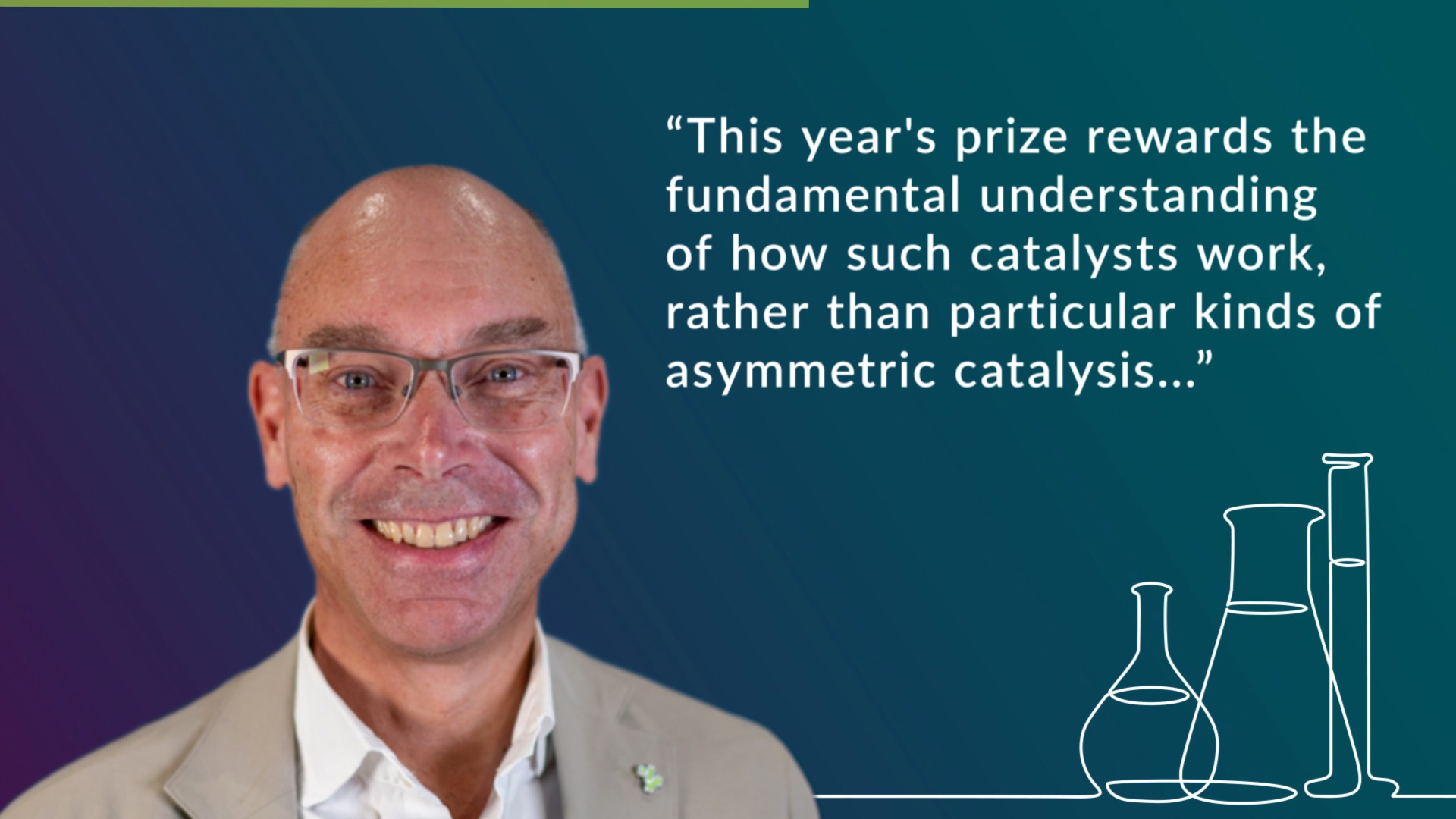
“Most chiral pharmaceuticals are produced with the handiness that have the desired biological properties. In order to do this, you use asymmetric catalysis – an area of organic chemistry that has been awarded the Nobel prize in chemistry many times before, most recently in 2021. This year’s prize rewards the fundamental understanding of how such catalysts work, rather than particular kinds of asymmetric catalysis that are routinely used for the production of pharmaceuticals and other products. It was Henri B. Kagan, who already in the 1980s presented examples of reactions and presented the theoretical models for how such non-linear effects could be seen in asymmetric catalytic reactions” says Per Arvidsson.