As a national SciLifeLab Infrastructure Unit based at Karolinska Institutet, we work as collaborative scientific partners with research teams across Sweden and internationally. We co-design experiments, engineer custom cell models through precision genome editing, and perform state-of-the-art functional genomics screens to enable discoveries that would otherwise be difficult or impossible.
Whether you need a robust, high-quality fee-for-service workflow or in-depth technological co-development, CFG can tailor its expertise and infrastructure to your research question.
Core Capabilities & Technologies
Our infrastructure is built around two complementary capabilities:
1. Massively Parallel Pooled CRISPR Screening
Interrogate dozens to tens of thousands of genes or genetic elements in parallel using unbiased genome-wide screens or focused, hypothesis-driven libraries.
Genetic perturbation at scale
We perform a broad range of CRISPR-based perturbations, including:
Loss-of-function screens: gene knockout and transcriptional repression (CRISPRi)
Mutagenesis screens: tiling mutagenesis of protein-coding genes and regulatory elements, including enhancers, promoters, UTRs, and other functional regions
Diverse phenotypic readouts
Choose readouts matched to your biological question, including:
Survival and cellular fitness
FACS-based phenotypic selection
Perturb-seq and CROP-seq (single-cell transcriptomic readout)
Cell morphology and other imaging-based phenotypes including spatial transcriptomics (optical pooled screening, in development).
Custom and off-the-shelf guide libraries
Our screening libraries incorporate Random Sequence Labels (RSLs) to increase statistical power and enable lineage tracing.
We provide ready-to-use genome-wide libraries for:
CRISPR knockout
CRISPRi
CRISPRa
We also design, clone, and package bespoke lentiviral libraries for Cas9, Cas12a, Cas13b, and Cas13d, tailored to specific genes, pathways, genetic elements, or experimental models.
Model systems
Our screening capabilities span:
Human and mouse cell lines for large-scale screens
Primary cells and stem cells for smaller-scale screens
In vivo screening in mouse models
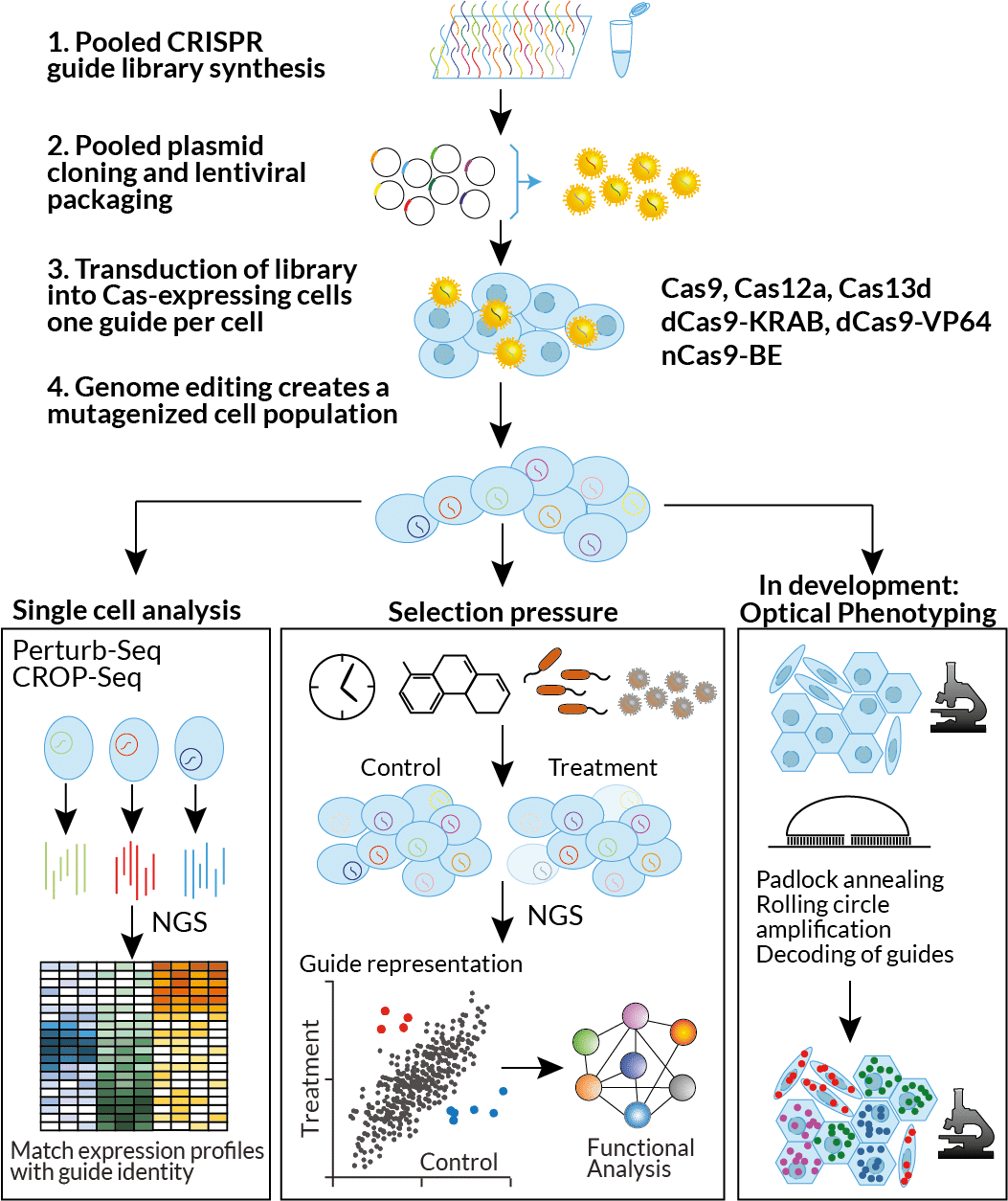
Pooled genetic screening modalities offered at CFG. Top. Pooled CRISPR screening involves the stable integration of DNA encoding a single guide RNA (sgRNA) into each Cas-expressing cell, generating a mutagenized cell population. The integrated sgRNA-encoding DNA acts as a “barcode”, linking each cell to a specific genetic perturbation. Bottom middle. Standard pooled screen. After applying a selective pressure or sorting out a specific phenotype, the relative enrichment or depletion of specific sgRNAs in the selected cell population is analyzed through next-generation sequencing (NGS). Bottom left. Readout of both guide and transcriptome in single cells (Perturb-Seq, CROP-Seq, in collaboration with the single-cell capabilities at NGI. Bottom right. Microscopic cell phenotyping and readout of guides directly on the microscopy slide by hybridization-based detection (in collaboration with the SciLifeLab ISS unit).
2. Precision Genome Engineering
We provide flexible, custom gene-editing solutions in human and non-human cell lines, as well as selected primary-cell and stem-cell models.
A full-spectrum genome-editing toolbox
Our methods include:
Indel-based editing
Targeted deletions
Homology-directed repair (HDR)
Base editing
Prime editing
These approaches can be used to generate precise knockouts, knock-ins, point mutations, reporter tags, and other targeted genomic modifications.
Integrated editing workflow and analytics
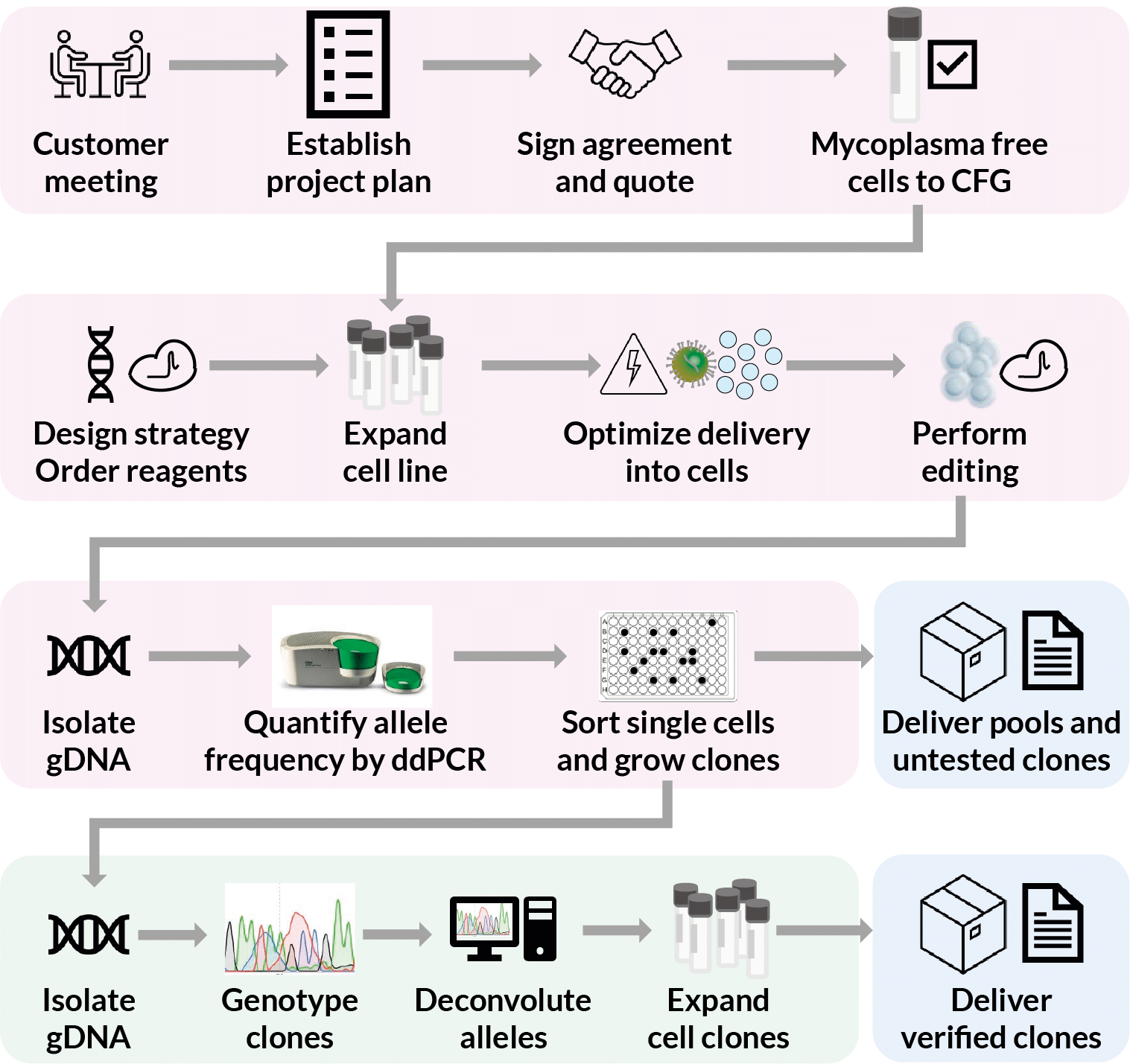
We provide an end-to-end workflow covering:
Experimental strategy and guide design
Transient delivery using Neon NxT electroporation
Direct quantification of editing efficiency using droplet digital PCR (ddPCR) and/or in-house nanopore sequencing
Single-cell FACS sorting
Clone expansion
Genotyping and validation
This integrated approach enables efficient progression from experimental design to validated engineered models
Workflow precision editing projects.
Cross-facility collaborations
CFG works closely with complementary SciLifeLab and university infrastructures to extend the scope of genome engineering projects:
Generate precisely engineered knockout, knock-in, point-mutant, reporter, and other cell models for functional validation, mechanism-of-action studies, and disease modelling.
Discover targets and genetic dependencies
Identify essential genes, synthetic lethal interactions, drivers or suppressors of a phenotype of interest, and other context-specific genetic dependencies across cell types, disease states, or experimental conditions.
Map drug–target interactions
Use high-resolution base-editing and scanning mutagenesis approaches to map functional protein domains, critical residues, and potential drug-binding sites at amino-acid resolution.
Dissect biological pathways
Systematically identify genetic regulators of reporter activity, protein stability, cellular phenotypes, and other biological processes. Combine CRISPR perturbations with single-cell transcriptomics and other high-dimensional readouts to resolve complex biological mechanisms.
From experimental design to biological insight
CFG can support projects across the entire experimental workflow – from strategy development and reagent design to genome engineering, screening, data generation and data analysis.
Through close collaboration with complementary SciLifeLab infrastructures, we can help integrate CRISPR-based approaches with chemical biology, proteomics, genomics, single-cell technologies, and bioinformatic analysis
Practical Information
CFG is an academic, non-profit national infrastructure unit open to researchers in academia, healthcare, and industry across Sweden and internationally.
Start with a consultation!
We offer an initial project consultation at no charge. CFG experts can assess experimental feasibility, discuss appropriate technologies and workflows, and provide a project-specific quotation. Whether you need a standard fee-for-service workflow or are looking for custom technological development, contact us to discuss your project and receive a tailored proposal.
At SciLifeLab, we use necessary cookies to ensure that the website works properly for you. We also want to use cookies for web analytics to help us improve the website. You can change your cookie settings at any time. How we use cookies
Functional
Always active
The technical storage or access is strictly necessary for the legitimate purpose of enabling the use of a specific service explicitly requested by the subscriber or user, or for the sole purpose of carrying out the transmission of a communication over an electronic communications network.
Preferences
The technical storage or access is necessary for the legitimate purpose of storing preferences that are not requested by the subscriber or user.
Statistics
The technical storage or access that is used exclusively for statistical purposes.The technical storage or access that is used exclusively for anonymous statistical purposes. Without a subpoena, voluntary compliance on the part of your Internet Service Provider, or additional records from a third party, information stored or retrieved for this purpose alone cannot usually be used to identify you.
Marketing
The technical storage or access is required to create user profiles to send advertising, or to track the user on a website or across several websites for similar marketing purposes.