
New DDLS Fellow: Marcel Tarbier
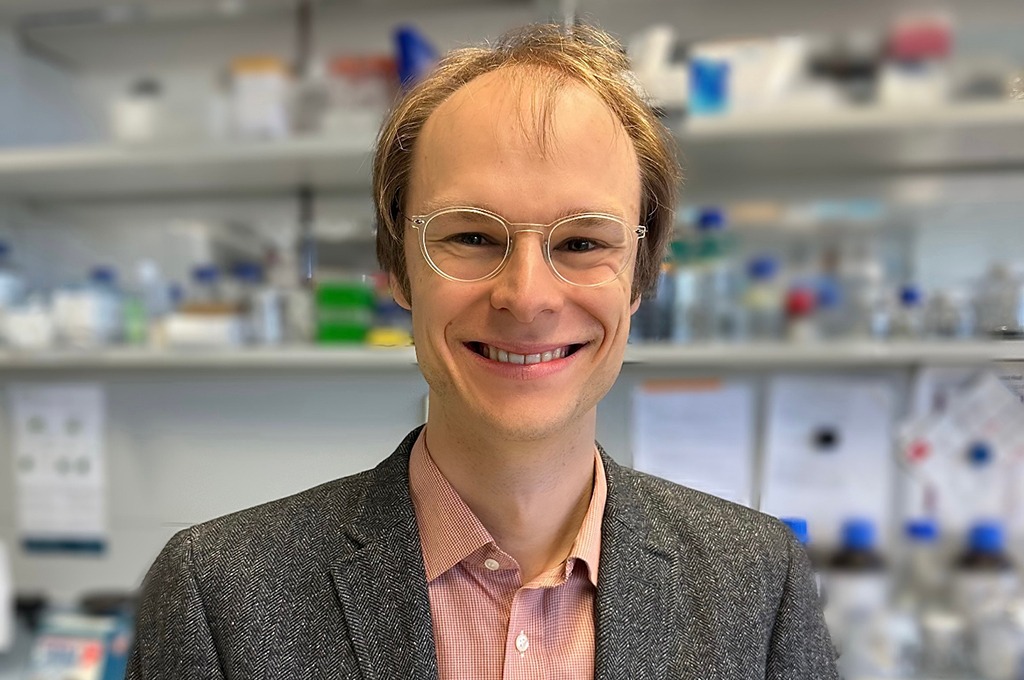
The SciLifeLab & Wallenberg National Program for Data-Driven Life Science (DDLS) continues to recruit outstanding early career scientists. One of your latest DDLS Fellows, Marcel Tarbier (Uppsala University), develops computational methods to decode the subtle molecular footprints that reveal how cells live, interact and change over time. In our latest Q&A-style article, he talks about how combining insights into gene regulation, advanced statistics and custom-built computational tools can help uncover hidden cellular states and improve our understanding of cancer and other complex diseases. Marcel belongs to the DDLS Precision Medicine & Diagnostics research area.
Marcel has always straddled the lines between mathematics, computer science and biology. He first studied Biology at Dresden University of Technology, focusing on gene technology and biotechnology, before switching to bioinformatics and systems biology at the Faculty of Engineering at Albert-Ludwigs-Universität Freiburg. This culminated in a thesis in computational neuroscience at the Bernstein Center, in collaboration with KTH. He then moved to Stockholm University for his PhD in Molecular Biosciences (in practice, computational biology) in Marc Friedländer’s lab, where he studied subtle gene expression differences between virtually identical cells and graduated with the best thesis in the biology section.
He had always seen himself primarily as a basic research kind of person, but when Marcel joined Vicent Pelechano’s lab at Karolinska Institutet for his postdoc, and thereby completing his “Stockholm shuffle”, he discovered how much he also enjoyed applying his skills to medical questions, and cancer heterogeneity in particular. Beyond that, he has the great honor and privilege of having been accepted to the Swedish Young Academy in 2025.
How do you think your expertise can contribute to the program?
I think my main contribution is the combination of really sound understanding of gene regulation, advanced statistics and custom programming. Our team doesn’t solve problems by finding the right tools, our team develops the right tools – and that just takes a lot of expertise: What technical biases are we dealing with? What biological biases do we need to consider? Can we adjust for any of them? Do our results make sense biologically? And knowledge just gets you so far. A lot of the magic comes from unconventional, creative and orthogonal approaches. We need all kinds of expertise to push forward. Having a grasp of various domains at once is one of them.
Shortly describe your research in an easy to understand way.
Humans are very much shaped by their age, families (ancestries) and friends (associates). Similarly, individual cells are shaped by their age (cell cycle phase), ancestry (lineage relationships) and associates (micro-environment). But these “features” are often hard to measure directly. So, the alternative is inferring them. To get back to our human examples, looking at how much time humans spend at bars, schools or doctors may give us information about their age. People who spend the exact same time at home and at hobbies may be family members. A person with their windows closed may live next to a family having a BBQ. There are a lot of subtle hints that inform us about these features if we pay close attention and use sensitive approaches. That’s exactly what we do! We observe molecular profiles of cells and figure out which subtle footprints inform us about their complex lives.
How do you think the program and interactions with the other DDLS-Fellows will benefit you?
In every possible way. Bioinformaticians are usually the odd one out. You are in a group of amazing life scientists, but all the feedback you get is on your questions and results – never on your methods. Having a community that focuses on computational methods is incredibly valuable. “Have you tried algorithm X”, “I think you have a bias in analysis Y”, “You could get more information out of your data by considering Z”. These are the comments that really inspire progress in bioinformatics, and these are the interactions that DDLS enables.
Name one thing that people generally do not know about you.
That very much depends on the people. Maybe the most relevant aspects are that I was a committee enthusiast in my student life: I was on the recruitment committee, the stipend committee, the faculty board, the senate’s committee for education, the executive board of the students’ parliament and even the experts’ pool for higher education assessment of the European Students’ Union. For some of that work I received a letter of appreciation from the German Ministry of Research and Education. Others may be surprised that I enjoy archery as well as board and computer games (and karaoke, thanks to Luisa!).
Where do you see yourself in five years regarding the DDLS aspect?
I always aim to solve problems people think to be impossible. If in 5 years people say about my work: “I didn’t think that was possible”, that would be the greatest achievement. They should think about my team as the ones that make the impossible possible. That would be rewarding for me – independent of citations or CNS papers.
In one word, describe how you feel about becoming a DDLS-Fellow.
That’s so much easier in German, where you can just mash many words together. If I had to pick one: humbled. It’s awesome to be in the company of so many amazing fellows, and it’s both rewarding and encouraging to be one of them.