
Searching for molecules that can stop bacteria in their tracks
What happens when molecules naturally found in the gut are put up against aggressive bacteria?
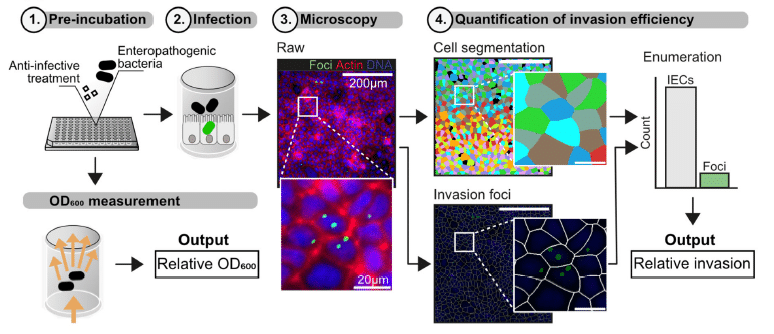
In a new study published in Gut Microbes, SciLifeLab Group Leaders and Fellow alumni Mikael Sellin and Daniel Globisch, together with their teams, describe a screening system that can look at two things at once. It can show whether a molecule affects bacterial growth, but also whether it affects the ability of bacteria to invade human cells. This is something that previously wasn’t measurable with standard antibiotic testing assays.
The study was made possible by the close collaboration between infection biologist Alexandra Bergholtz from the Sellin lab and organic chemists Weifeng Lin and Amanpreet Kaur from the Globisch lab.
In the project, they screened a collection of gut metabolites against Salmonella and Shigella. They identified around 150 molecules that blocked either bacterial growth or the bacteria’s ability to invade cells.
Indole, a small chemical compound naturally found in the human gut, was one of the molecules they investigated more closely. A small change made a surprisingly large difference. Adding a methyl group to certain carbon positions made indole much more potent as an anti-infective molecule. Adding the same group to a nitrogen instead removed the effect.
A merger of research interests bound to happen
The project grew out of two existing areas of research.
“Our lab has had a long-standing interest in the mechanisms that aggressive bacteria use to attack the body’s mucosal linings, with a particular focus on the gut,” says Mikael Sellin.
Previous observations had shown that gut metabolites, such as short- and medium-chain fatty acids, can play an important role in turning this aggressive behavior on or off.
At the same time, the Globisch lab had acquired a chemical library with authentic standards of metabolites present in the human gut based on their interest in microbiome-derived metabolites .
The two groups started building their laboratories around the same time through the SciLifeLab Fellows program. Networking opportunities within the SciLifeLab community helped put the researchers in contact and make them realize that there was common ground to explore.
“This interdisciplinary project has been possible due to the different scientific expertise in both labs. My laboratory provided compounds and performed chemical synthesis for the sophisticated assays in Mikael’s lab,” says Daniel Globisch. “It has been a fun journey.”
The COVID-19 pandemic put constraints on the original plans for the research because some of the intended metabolite sources became inaccessible.
“When we finally had the chance to sit down for a coffee face-to-face again, it took only a few minutes to realize that there was an ideal pilot library already available within the Globisch lab scientific network,” Sellin says. “From there, the project really took off.”
Taking the next step
The researchers are now working to further adapt their organoid-based infection models. The goal is to evaluate the effectiveness of new antibacterial therapies in infected human 3D tissue replicas, and to do this at a larger scale.
“With antibiotic resistance rising, experimental tools and insights like these, grounded in molecules our bodies and microbiomes produce, teach us about the fundamentals of infectious disease and can provide potential future therapeutic leads,” Sellin concludes.
This project was made possible through financial support from SciLifeLab, the Swedish Foundation for Strategic Research, the Swedish Research Council and the Uppsala Antibiotic Center.
DOI: 10.1080/19490976.2026.2728235
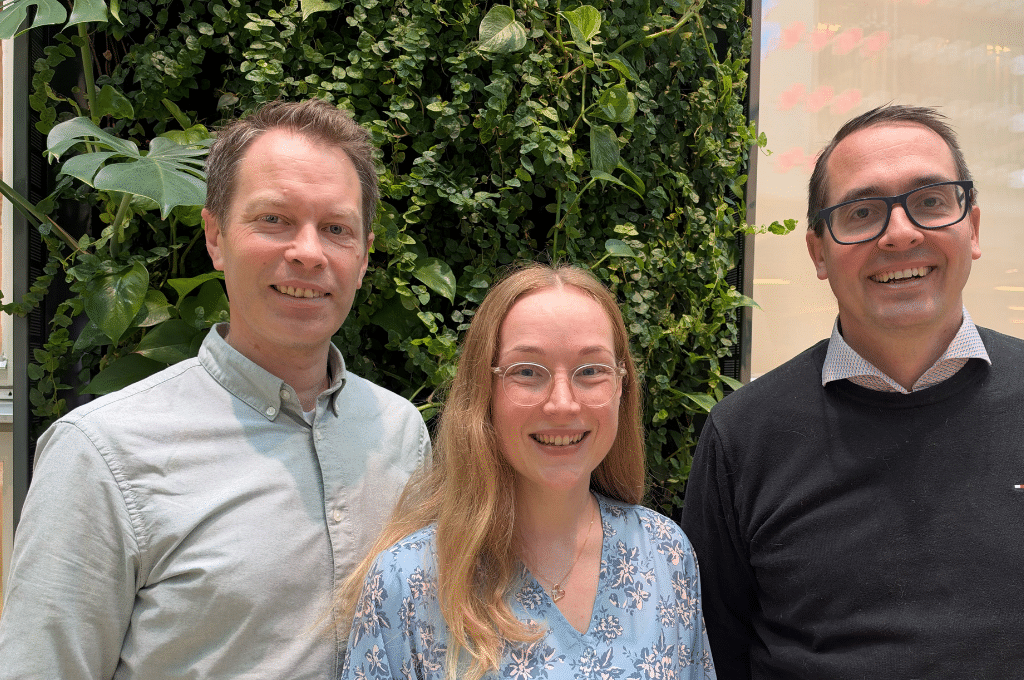
In the photo (from left to right): Mikael Sellin (SciLifeLab Group Leader), Alexandra Bergholtz (first author of the paper), and Daniel Globisch (SciLifeLab Group Leader).