
A. Lundberg Lab
Mapping inflammation-mediated tumor plasticity and therapy resistance with multi-omics and multi-modal AI
The A. Lundberg Lab investigates how inflammation-driven signals, immune–metabolic rewiring, and tumor–microenvironment interactions shape tumor evolution, lineage plasticity, and therapy resistance in aggressive cancers, with a primary focus on metastatic prostate, and complementary studies in breast and head & neck cancer and brain tumors.
We integrate multi-omics, AI and machine learning, and clinically anchored translational analysis to identify prognostic mechanisms, predictive biomarkers, and therapeutically actionable vulnerabilities.
Profile
The lab is led by Assistant Professor Arian Lundberg (PhD, MSc), a Knut and Alice Wallenberg & SciLifelab, Data-Driven Life Science (DDLS) Fellow in Precision Medicine and Diagnostics, whose background spans Karolinska Institutet (Sweden), Stanford University, University of California San Francisco (USA) and the Institute of Cancer Research/Royal Marsden Hospital (UK).
Our research combines computational modeling, mechanistic inference, and large-scale clinical cohort analysis to uncover how inflammatory, metabolic, and microenvironmental pressures drive cancer progression.
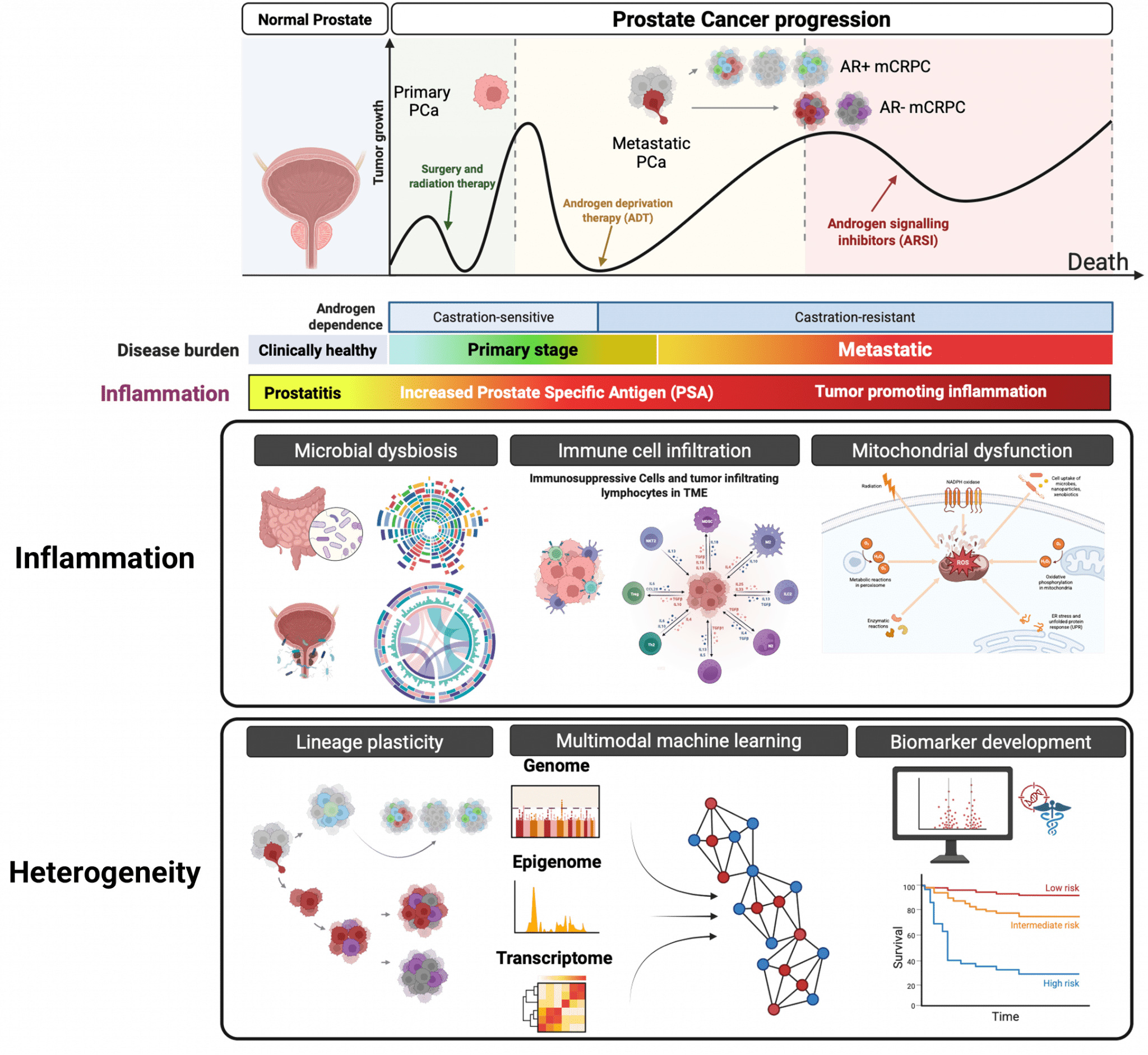
Research Focus
1. Inflammation-driven tumor evolution in metastatic prostate cancer
We dissect transcriptional, regulatory, and metabolic programs that enable therapy escape, lineage plasticity, and metastatic progression.
2. AI- and ML-powered multi-omics biomarkers
We develop prognostic and predictive models for survival, treatment response, immune infiltration, mitochondrial activity, and aggressive tumor states across prostate, breast, and head & neck cancers.
3. Immune–metabolic and microenvironmental rewiring
Using integrative omics and deep learning, we map how inflammatory signals reshape cellular phenotypes during treatment and disease progression.
4. Microbiome–tumor–immune interactions
We investigate microbial–host inflammatory interactions and their contribution to tumor aggressiveness.
The lab leads one of the largest Swedish and international efforts to characterize the tumor-associated microbiome using harmonized pipelines across major clinical cohorts.
Vision
Our mission is to build an AI-driven, mechanistically informed framework to predict and target inflammation-driven tumor evolution, accelerating precision oncology for the most lethal cancer phenotypes.
Group Members
Alexandra Rafeletou, MSc (PhD student)
Tatjana Kiseļova, MSc (PhD student)
Selma Bozorgpana (Visiting PhD student)