Addressing Antimicrobial Resistance with AI and Data-Driven Approaches
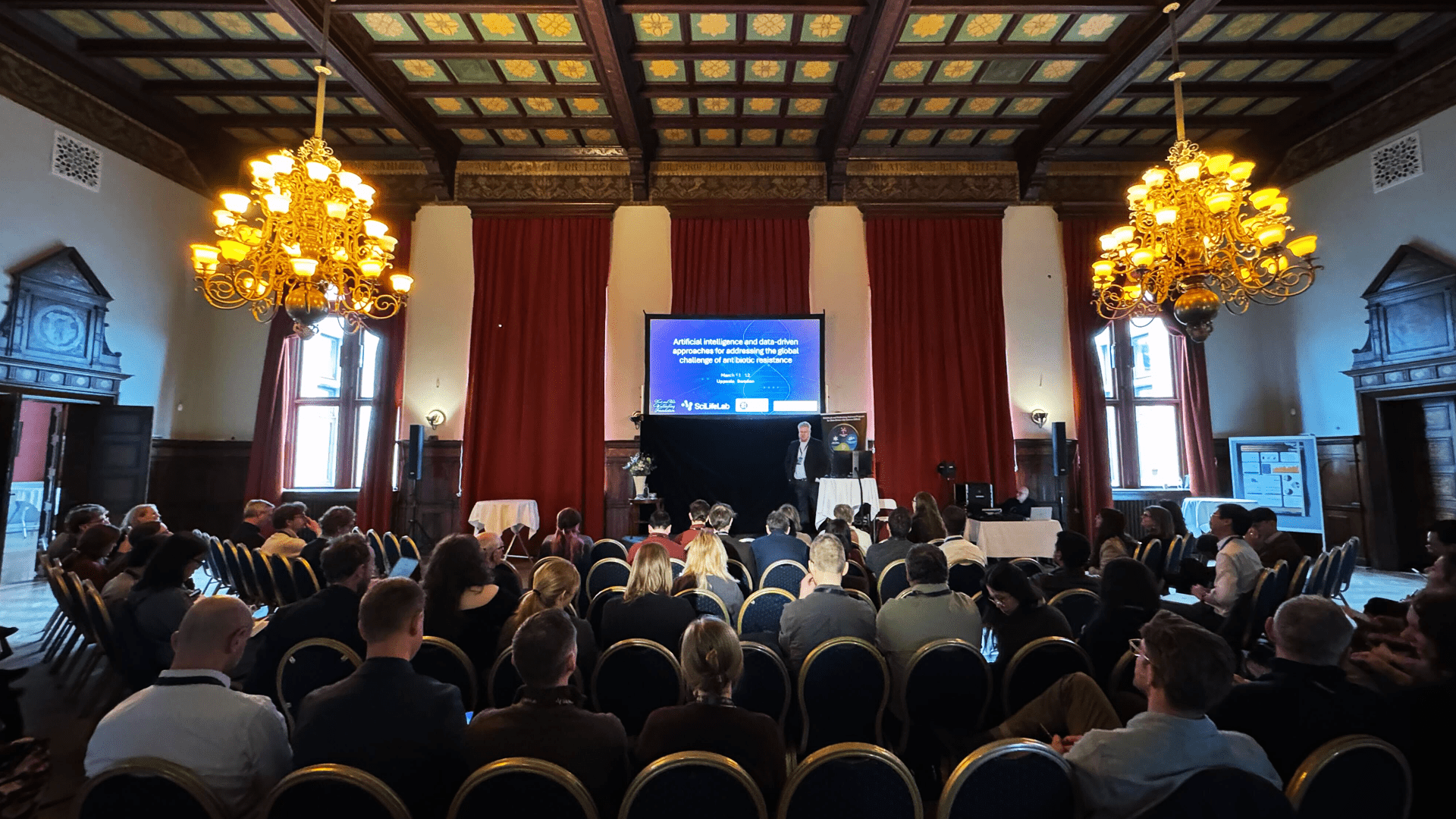
Yesterday, researchers and experts gathered at Norrlands Nation in Uppsala for the Artificial Intelligence and Data-Driven Approaches for Addressing the Global Challenge of Antibiotic Resistance event, organized within the Epidemiology and Biology of Infection research area of the SciLifeLab and Wallenberg National Program for Data-Driven Life Science (DDLS). The event focused on how AI and other data-driven approaches can help address antimicrobial resistance (AMR).
Professor Alison Holmes, Director of the Fleming Initiative, emphasized the importance of grounding AI in practice and real-world use, including “an understanding of the real-world and the real-world contexts in which these insights could be applied.”
Professor Erik Kristiansson, DDLS Co-Director and Professor at Mathematical Sciences, Chalmers University of Technology, highlighted the broad potential of computational and AI-based methods, from diagnostics and more targeted antibiotic treatment to genomics, metagenomics, and faster development of new antibiotics.
“New computational methods, including AI-based approaches, offer promising ways to address the growing challenges posed by infections caused by antibiotic-resistant bacteria,” noted Kristiansson.
The program also included Nick Moser of Google DeepMind, hosted at the Fleming Initiative and Imperial College London, UK, who highlighted the potential of AI across the AMR field, particularly for diagnostics, rapid detection, and more targeted intervention.
“With the right suite of diagnostic tools with epidemiological tracking of infectious diseases and resistance strains, we can finally enable targeted intervention to mitigate AMR,” said Moser.
The event continues today with more speakers and discussions, jointly organized by the DDLS program and the Fleming Initiative, a partnership between Imperial College London and Imperial College Healthcare NHS Trust, with support from the UK Science and Technology Network.