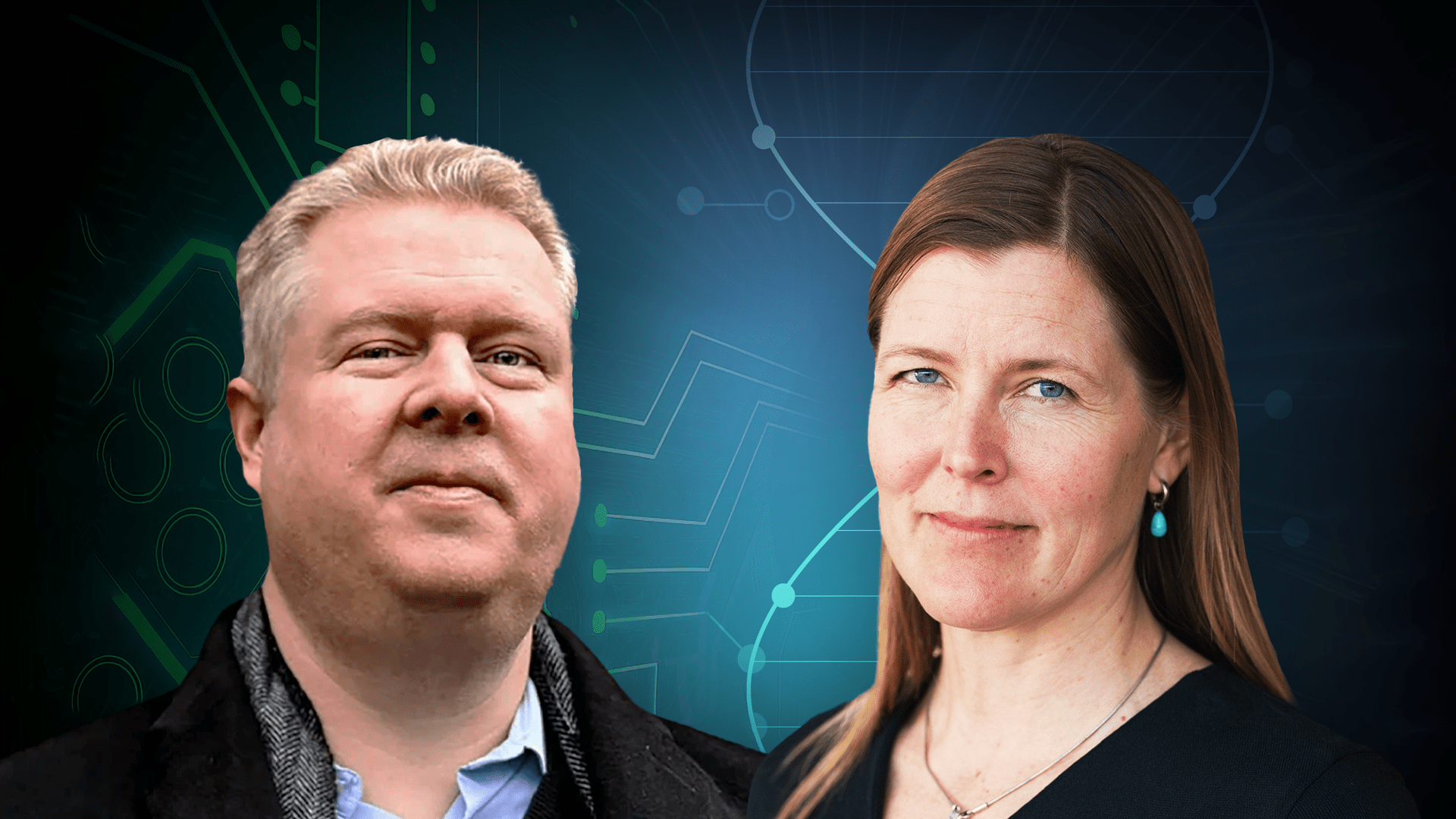
Perspectives from our new DDLS Co-Directors Carolina Wählby and Erik Kristiansson
As the SciLifeLab and Wallenberg National Program for Data-Driven Life Science (DDLS) enters its next phase, our two new Co-Directors, Carolina Wählby (Uppsala University) and Erik Kristiansson (Chalmers/University of Gothenburg), reflect on strategy, training, interdisciplinarity, technology, and inspiration. Their responses highlight both shared priorities and personal approaches to leadership in a rapidly evolving scientific field.
Shaping the next phase of DDLS
Carolina Wählby describes the importance of identifying what will matter most as the program continues to expand:
“Now that new recruitments and infrastructure investments are starting to fall into place, I want to start by figuring out what the true bottlenecks are. I believe we will benefit from aiming for large and ambitious projects involving multiple partners, and a luxury of data driven research is that it is fairly easy to collaborate across organizations. Key is however to find one another, and to communicate ideas and expertise, and I hope I can contribute here.”
Kristiansson emphasizes the shift toward research impact and national cohesion:
“The transformation of the life sciences is underway, and I believe the DDLS is exceptionally well-positioned to drive this progress. In the next phase of the program, the primary focus will be on producing high-quality, relevant research. This will be driven by the recruited expertise, especially the fellows who will become future research leaders in this field, and the next generation of data-driven scientists trained by the research school. Maintaining close ties with the national research community will be critical for success.”
Building skills and networks for the future
Training and education remain central to DDLS. Wählby highlights the importance of both course content and the human connections that make learning possible:
“The content of the courses offered within the research school and postdoc program will of course be important, but even more important is to get the networking started and to encourage scientists to learn from one another. This is a very fast-moving field, and I believe successful research projects will require a deep understanding of both data, technology, and the underlying biological and medical questions. We all need to learn how to step out of our comfort zones and be the ones asking ‘stupid’ questions. I believe the new generation of life scientists will evolve towards multilingual researchers that can communicate across disciplines feeling comfortable talking to both wet-lab scientists and computer scientists.”
Kristiansson points to the interdisciplinary strengths developing within the program:
“DDLS is building an interdisciplinary research community that combines the life sciences with AI and machine learning. The fellows and their research groups form the foundation, which ongoing recruitment will further strengthen. DDLS will continue to enable and promote collaboration and networking, promoting knowledge sharing across scientific boundaries. We will also support training to help the community improve their skills in data-driven methods.”
AI and data
When asked how her own research at the interface of imaging, AI, and cell biology might influence the next wave of data-driven life science, Wählby responds:
“I love image data, especially since it is such an excellent basis for communicating ideas and building hypotheses understandable across disciplines. In my view, it is via analysis of image data that AI first entered life science, and today we can for example use spatial omics as a complement to visual assessment by pathologists when annotating data, making the techniques even more powerful. I also believe imaging and spatial omics will be useful when answering questions related to development and evolution.”
Asked about the data foundations needed to enable AI methods in the life sciences, Kristiansson highlights the importance of well-organized, harmonized datasets:
“High-quality data is key to developing effective AI-based methods. However, a major challenge in the life sciences is the vast heterogeneity of the data. It is crucial not to underestimate the effort needed to collect, organize, and harmonize data to create sufficiently large AI-ready datasets. Data support will continue to be a primary focus in the DDLS, leveraging both data generated within the SciLifeLab infrastructure and the rapidly growing open datasets available in public repositories.”
Interdisciplinarity and scientific culture
Wählby defines true interdisciplinary research as something deeper than cooperation:
“True interdisciplinary research is not about sharing data or helping one another, but about exploring a joint research question with true excitement, where both partners see potential for new knowledge and development within their own discipline, where the sum is more than its parts. Curiosity and patience are very important ingredients, as well as openness and a willingness to re-think and re-start over and over again when meeting obstacles. And one should never underestimate the importance of a discussion over a good cup of coffee.”
She also emphasizes the cultural dimension:
“This is of course a grand challenge, and I’m sure we will meet many hurdles on the way. Creating culture starts with a willingness to take a step back, re-think and re-design, and most of all to be creative, together with others.”
Kristiansson reflects on collaboration with WASP and WASP-HS:
“Knowledge transfer has been vital to developing AI methods for life sciences. For example, the transformers that form the basis of many biological foundation models were originally created for natural language processing. DDLS will continue to grow its collaboration with WASP and WASP-HS by encouraging research that combines critical life science domain knowledge with cutting-edge AI expertise. I believe that the combined strengths of these programs will position Sweden at the forefront of life science AI.”
From data to societal benefit
Kristiansson also highlights the work needed to translate research into real-world impact:
“Transforming science into societal impact is an important task for the DDLS program. Many obstacles still hinder the adoption of data-driven methods in clinical settings and other critical decision-making, such as environmental regulation. A major challenge is the lack of large, representative datasets needed to test methods in realistic situations. I believe that Sweden can and must improve in this area — much data exists, but there is still a lack of procedures to make it accessible to researchers. Here, DDLS should serve as a facilitator to ensure that the valuable research produced within the program benefits society as much as possible.”
Personal reflections and sources of inspiration
When asked what inspires her outside of research, Wählby highlights the value of everyday activities, time outdoors, and time with family:
“Long morning walks with my dog as the sun rises in Hågadalen is a luxury. My kids (all more or less grown up and two of three studying out of town) give me perspective. I play floor hockey, do woodworking, have a cinema club, and enjoy a glass of wine with friends every now and then – a mix of everything!”
Kristiansson was asked a similar question about how he stays curious and finds inspiration beyond science. He ties his motivation to a long-standing interest in learning and music:
“Staying curious has never been a problem for me. I always enjoy learning new things and exploring different areas, which is one reason I transitioned from mathematics to data-driven life science. Music has always been my primary source of inspiration — I’m a big opera fan, but I also enjoy many other, more obscure genres.”
Carolina: Photo: UU, David Naylor
Erik: Photo: Chalmers, Daniel Stahre