SciLifeLab Voices: Erik Fransén
This time in our SciLifeLab Voices series, we spoke with Erik Fransén, SciLifeLab Group Leader and Professor of Computer Science at KTH Royal Institute of Technology. Erik is principal investigator leading a research group in time-series machine learning, computational neuroscience, and computational medicine.
How did you end up at KTH and SciLifeLab?
Working closely with experimental groups in the life sciences area mean the localization to SciLifeLab was a natural choice. I obtained a PhD in Computer science at KTH after completing a BSc in physics from Uppsala. Next I did a postdoc at Harvard at the Psychology department and then returned to KTH. I have had joint projects with medical experimental groups at KI, KS, Boston U, McGill U, Universitätsklinikum Mannheim, as well as collaborating with AstraZeneca and currently the MedTech company Getinge.
What does a typical day look like?
As a group PI, I have meetings with postdocs, master’s thesis students, research organization meetings, give lectures to undergraduate students, and I participate in daily research activities.
What’s the best part about being affiliated with SciLifeLab?
The environment. Interacting with very competent and enthusiastic colleagues in a field of science that shows a tremendous progress. Also the breadth of work is amazing and opens up for a lot of opportunities to interact.
Looking back, what has been the most rewarding or exciting part of your journey so far?
Our work with AstraZeneca on their novel compounds to treat chronic peripheral pain was phenomenally interesting. Together with my PhD students, we developed a model of the peripheral nerve to study mechansms of excitability changes in pain. This was paralleled by experimental work using novel compounds from AstraZeneca and this interaction between computational modeling, experiments and Big Pharma was very rewarding.
What are you most excited about for the next five years?
The new kind of data which is becoming available, time-resolved multi-channel molecular data. Getting into dynamics opens up for addressing causality and for me as a modeler to construct mechanistic models. Also, as biological data gets increasingly complex, the role of computational analysis and modeling becomes increasingly important, which of course is rewarding for a computational scientist.
What’s something your colleagues might be surprised to learn about you?
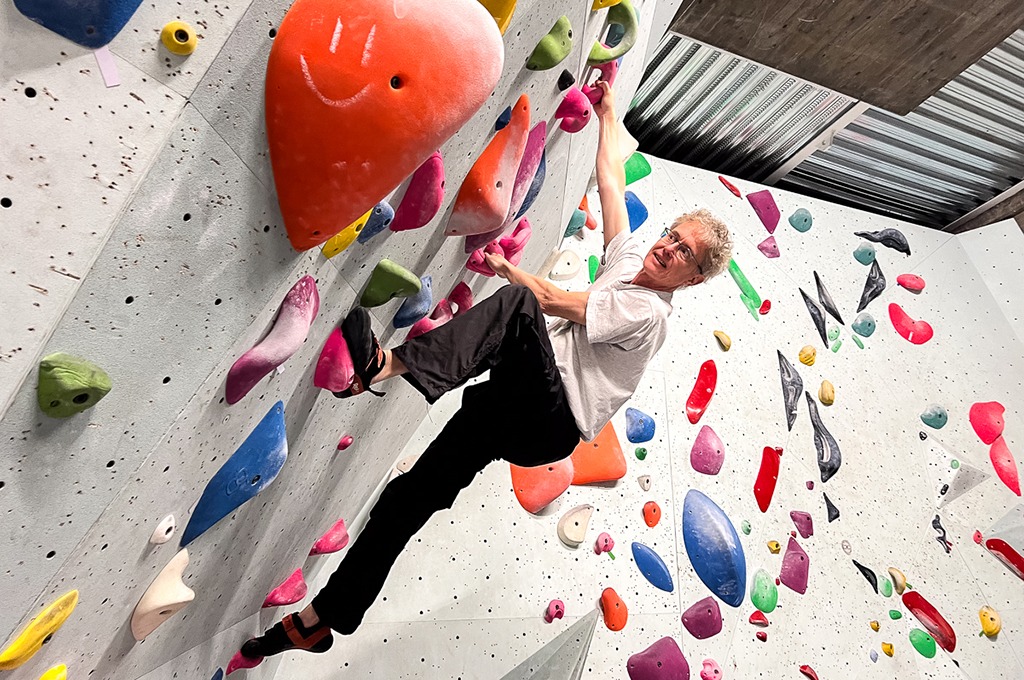
At home, I have an aquarium with shrimps originating from Hawaii. They are tiny and really very robust little critters. On my free time, I like to do climbing at the local climbing center as well as dancing Scottish country dance.Finally, what’s the last book or movie that really stayed with you?
Recently, I saw the movie ”The marching band” (”En fanfare” in French) which was very moving. Impressions that have stayed was from reading the book “This life” by Martin Hägglund where he discusses what makes life meaningful gave a lot of food for thought.