

Andrew Magee

DDLS Fellow, Umeå University

Key Publications

Magee, A. F., Holbrook, A. J., Pekar, J. E., Caviedes-Solis, I. W., Matsen Iv, F. A., Baele, G., … & Suchard, M. A. (2024). Random-effects substitution models for phylogenetics via scalable gradient approximations. Systematic Biology, 73(3), 562-578.

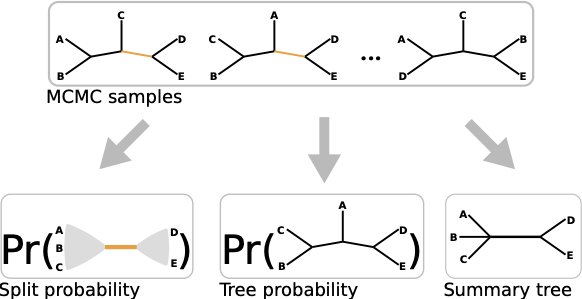
Magee, A., Karcher, M., Matsen IV, F. A., & Minin, V. M. (2024). How trustworthy is your tree? Bayesian phylogenetic effective sample size through the lens of Monte Carlo error. Bayesian analysis, 19(2), 565.

Hassler, G. W., Magee, A. F., Zhang, Z., Baele, G., Lemey, P., Ji, X., … & Suchard, M. A. (2023). Data integration in Bayesian phylogenetics. Annual review of statistics and its application, 10(1), 353-377.

Pekar, J. E., Magee, A., Parker, E., Moshiri, N., Izhikevich, K., Havens, J. L., … & Wertheim, J. O. (2022). The molecular epidemiology of multiple zoonotic origins of SARS-CoV-2. Science, 377(6609), 960-966.

Research Interest

As infectious diseases spread through populations, evolution leaves an indelible mark on their genomes. In our group, we are interested in turning this process around, using the genomes of viruses and other infectious agents to understand the history of transmission. Our key tool in this process is the phylogeny, the record of ancestry of the viruses. The phylogeny encodes spatiotemporal information about their spread through populations through both the evolutionary relationships of the viruses and their pattern of descent. Our main interests lie in developing models to best leverage the information available from phylogenies for quantifying disease transmission and in understanding the quality and limitations of available techniques.
Group Members

  • Andrew Magee

Last updated: 2026-04-01

Content Responsible: Sofia Falorni(sofia.falorni@scilifelab.se)