
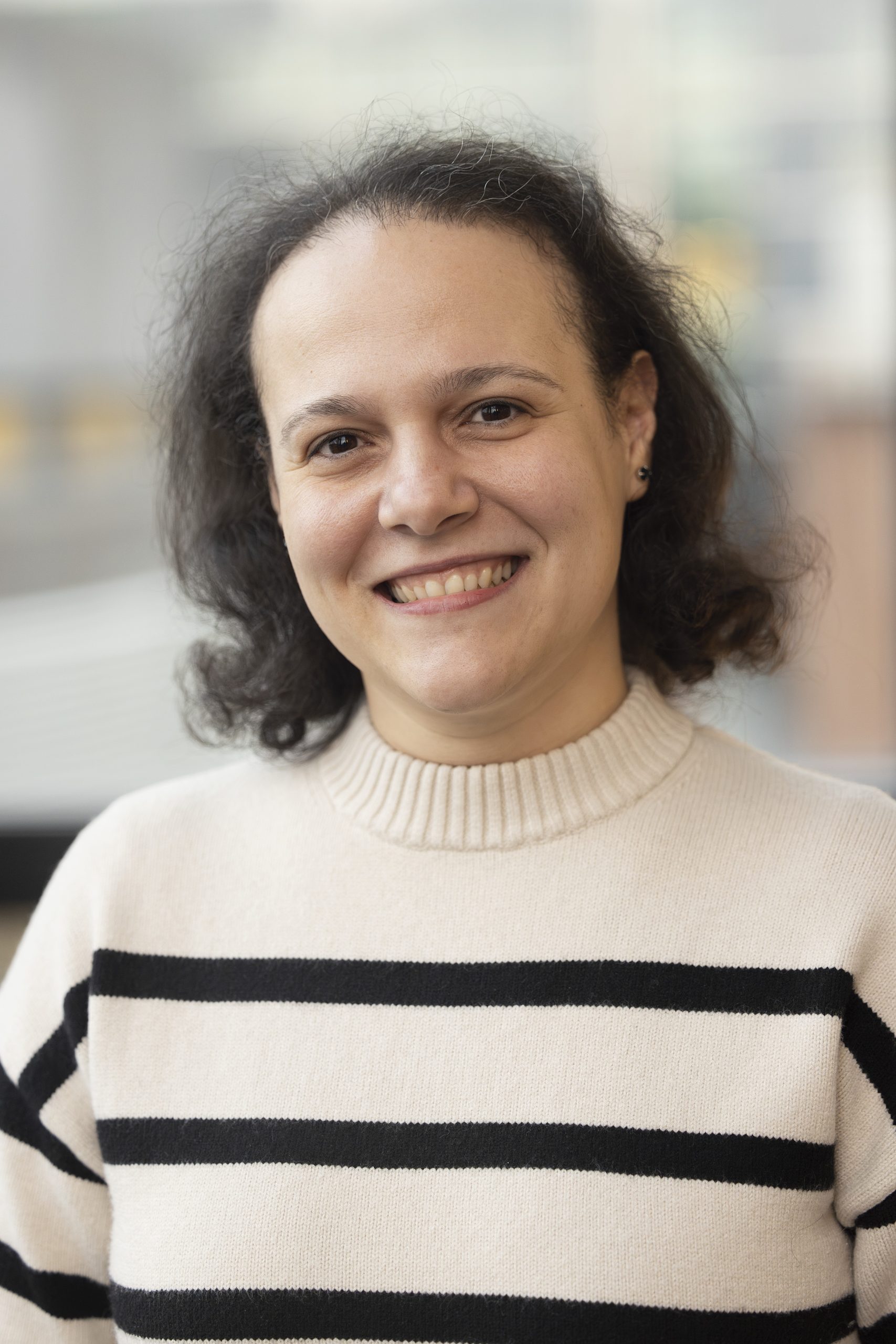
Gisele Miranda

Key Publications

Wang, J.H., Chu, C.Y., Colombelli, F., Du, C.W., Christensen, M.O., Pereda, J., Jakasa, I., Kezic, S., Thyssen, J.P., Hwu, E. and Miranda, G., 2026, May. Multicenter Morphometric Analysis of Stratum Corneum Nanotexture for Skin Barrier Assessment. In Medical Imaging with Deep Learning-Validation Papers.

Serrano, E., Peters, J., Wagner, J., Graham, R.E., Chen, Z., Feng, B.Y., Miranda, G., Kalinin, A.A., Vulliard, L., Tomkinson, J. and Mattson, C., 2026. Progress and new challenges in image-based profiling. Molecular systems biology, pp.1-35.

Franzén Boger, M., Hasselrot, T., Kaldhusdal, V., Miranda, G.H., Czarnewski, P., Edfeldt, G., Bradley, F., Rexaj, G., Lajoie, J., Omollo, K. and Kimani, J., 2024. Sustained immune activation and impaired epithelial barrier integrity in the ectocervix of women with chronic HIV infection. PLoS Pathogens, 20(11), p.e1012709.

Matsoukas, C., Hernandez, A.B., Liu, Y., Dembrower, K., Miranda, G., Konuk, E., Haslum, J.F., Zouzos, A., Lindholm, P., Strand, F. and Smith, K., 2020, November. Adding seemingly uninformative labels helps in low data regimes. In International Conference on Machine Learning (pp. 6775-6784). PMLR.

Miranda, G. H. B., Machicao, J., & Bruno, O. M. (2016). Exploring spatio-temporal dynamics of cellular automata for pattern recognition in networks. Scientific Reports, 6(1), 37329.

Miranda, G.H.B. and Felipe, J.C., 2015. Computer-aided diagnosis system based on fuzzy logic for breast cancer categorization. Computers in biology and medicine, 64, pp.334-346.

I am an Assistant Professor of Machine Learning for Computational Biology at KTH Royal Institute of Technology and a SciLifeLab Fellow. My research explores how AI can help us understand the organization and dynamics of biological systems across cellular and tissue scales.

My group develops machine learning methods to understand how cells organize, interact, and collectively shape tissue function. We are particularly interested in generative AI and multimodal learning as tools for uncovering biological principles from increasingly rich measurements of cells and tissues.

By integrating large-scale single-cell, spatial, imaging, and omics data, we aim to capture relationships between cellular identity, state, function, and spatial context. Our goal is to move beyond analyzing individual measurements toward models that reveal higher-order organization—helping us understand cellular networks, tissue microenvironments, and how these systems change across biological conditions.

Group Members:

  • Erik Serrano, postdoctoral researcher
  • Jen-Hung Wang, PhD student
  • Felipe Colombelli, PhD student

Last updated: 2026-08-18

Content Responsible: Hampus Pehrsson Ternström(hampus.persson@scilifelab.uu.se)