News: Chemical Proteomics is one of the two European EU-OpenScreen chemoproteomics parner sites.
The Chemical Proteomics unit (ChemProt) is a national unit expert on supporting drug discovery and development by proteome-wide deconvolution of targets and action mechanisms of small molecules.
ChemProt has recently developed high throughput (HT) chemical proteomics methods which outperform the previous methods for target deconvolution of at least tenfold and decrease by the same factor the time of analysis of the sample amount needed for each biological replicate. The novel methods can use a high level on multiplexing for several biological replicates, up to 16 per experiment according to the latest state of the art for quantitative proteomics. Different compounds or more than one biological system can be tested simultaneously. The LC-MS instrument park has been renewed for better supporting the new high throughput chemical proteomics.
Please feel free to contact us (massimiliano.gaetani@ki.se) and come visit us at KI Biomedicum. You will receive consultation free of charge, finding out about feasibility, details and better solutions for your project or your potential one.
ChemProt is also the national unit expert of Chemical Proteomics within the Swedish infrastructure for biological mass spectrometry (BioMS). ChemProt is responsible for the entire Chemical Proteomics technology and also provider of protein structural analysis through HDX-MS. Through BioMS and SciLifeLab we can support your project and cover relevant costs of it by national funding.
To book services of our unit please create a new application at the BioMS portal and when requested in the application form please select “Chemical Proteomics” as technology and then add “M.Gaetani” as BioMS contact.
Services
ChemProt makes use of proteome-wide orthogonal approaches to find out how small molecules work when incubated in cell cultures and in lysates. Most approaches can be provided with no molecular modification for chemical probe engineering. ChemProt can provide full pipelines reproducing the biological treatments of the phenotype of interest or operating the treatment planned with the users. ChemProt also offers hydrogen-deuterium exchange mass spectrometry (HDX-MS) for mapping and characterizing the target binding site, and monitoring other structural changes. Our outcomes include full data analysis, high confidence identification of most reproducible and treatment-specific MoA signatures and target candidates. Follow up support for consequent experimental and publication purposes are provided; consultation is always provided on request and free of charge, also to guide further planning.
Current Technologies and Services
Deconvolution of compound targets, determination of mechanism of Action (MoA) and off-target landscape through orthogonal methods of mass spectrometry-based deep proteomics
protein solubility alteration signatures in treated cell cultures and lysates;
changes in proteome redox balance in treated cell cultures.
Matches over two orthogonal approaches dramatically increase the chances to find the correct target. These methods are here listed:
Proteome Integral Solubility Alteration (PISA) Assay, a high throughput method that can identify targets and early mechanistic events of incubation of the drug in cell cultures or lysates by measuring biophysical changes at the proteome level rather than the total protein amount of global/expression proteomics as cell response to the treatment. PISA does not need chemical engineering of compounds, holds biological sample multiplexity (up to 18) per analysis, is also optimized for low sample amounts as in primary cell cultures or iPSCs derived models, and is fundamentally based on robust, proteome-wide, deep protein MS/MS-based identification and quantification (~10 000 across all replicates) by measuring changes of protein solubility upon application of a gradient of protein precipitation agents, such as gradients of temperature, solvent or ions, between compound-treated and controls or other molecules, conditions (time of treatment, concentration) with confident statistical ground (>3 biological replicates), (Gaetani M et al., J Proteome Res, 2019, DOI: 1021/acs.jproteome.9b00500);
Expression proteomics and FITExP, based on compound-specific proteome responses and with no need of chemical engineering of compounds (now up to 18-plex) (Chernobrovkin A et al., Sci Rep, 2015, DOI:1038/srep11176 );
ProTargetMiner, high throughput method to study anticancer compounds based on FITExP-derived database of proteome signatures using a library of anticancer molecules (Saei AA et al., Nat Commun, 2019; DOI:1038/s41467-019-13582-8);
Identification of interactions and protein complexes after affinity-based approaches using chemical engineered probes (now up to 18-plex)
RedOx Proteomics, for specific proteome changes in the reduction-oxidation balance
Protein Structural Analysis using Hydrogen-deuterium exchange mass spectrometry (HDX-MS)
Binding site mapping and characterization for: protein-small molecule interactions; protein-peptide interactions; protein-protein interactions, including epitope mapping;
Conformational changes monitoring to study effects of mutations, to analyze misfolding and for biosimilar characterization
Identification of enzyme protein substrates
Using a PISA-based approach in cell lysate with recombinant enzymes and their co-factors, or TPP-based approach only for academic users and with aims of characterizing the thermodynamics behavior of particular substrates (Nat Commun12, 1296 (2021) https://doi.org/10.1038/s41467-021-21540-6; bioRxiv 2022.08.24, doi: https://doi.org/10.1101/2022.08.24.505189)
Additional proteomics services related to / coordinated with the above
(e.g. PTMs, deep quantitative proteomics, etc.)
Equipment
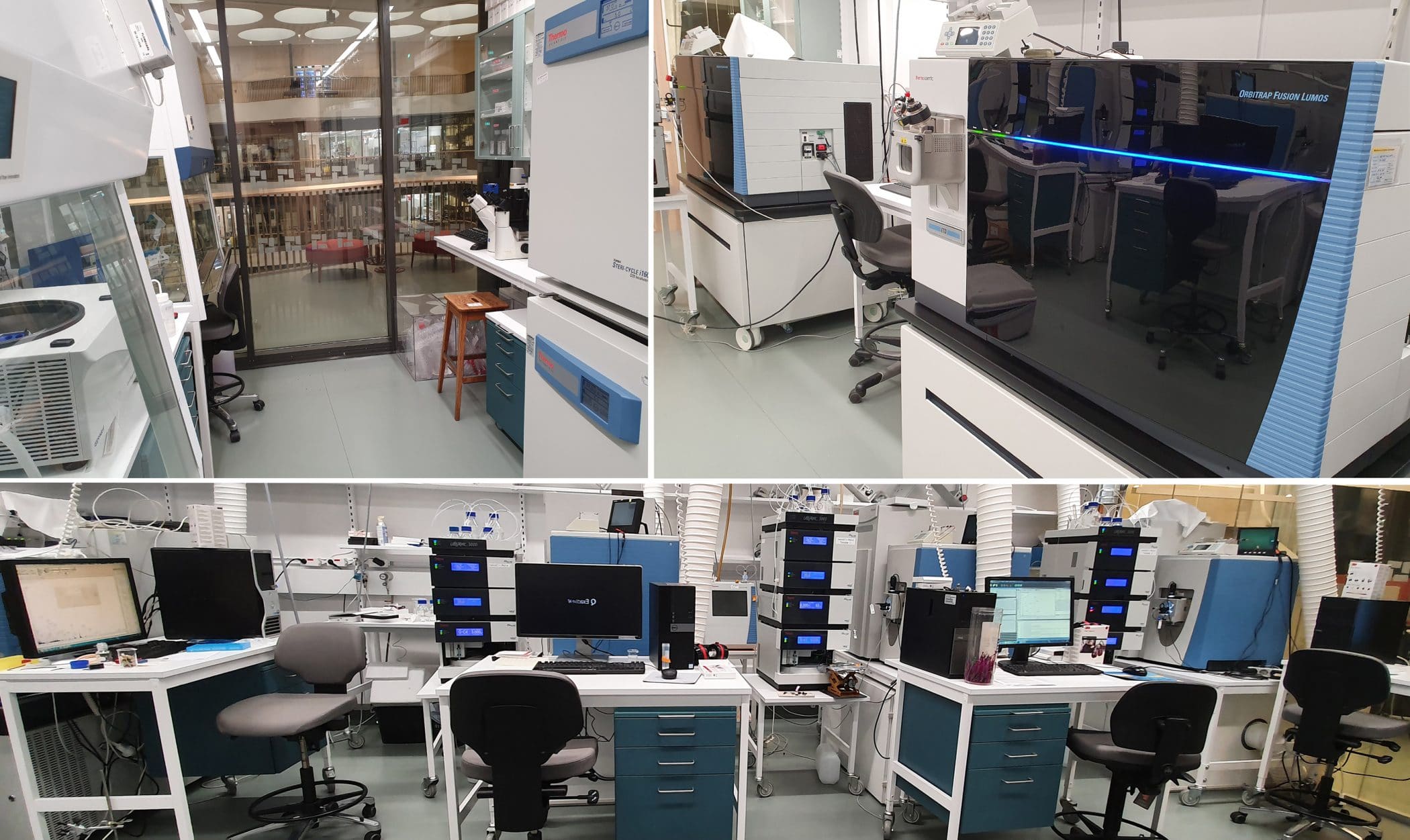
ChemProt laboratories are at located at the Department of Medical Biochemistry and Biophysics (MBB) of Karolinska Institutet, Biomedicum. ChemProt represents an innovative unit model offering complete pipelines and including different laboratories for cell culture, sample preparation, LC-MS and bioinformatic analysis.
Cell culture lab Instruments: Two laminar flow cabinets, Two CO2 incubators, Two Microscopes, Eppendorf centrifuge, BioRad cell counter, etc.
Centrifuges: Beckmann XPN-80 ultracentrifuge, Speedvac centrifuges , Eppendorf centrifuges for large and small tubes
Mass Spectrometers:
One Orbitrap Eclipse, Thermo Scientific
Three Orbitrap Exploris 480, Thermo Scientific
Two Tribrid Orbitrap Fusion Lumos, Thermo Scientific
One Orbitrap Fusion, Thermo Scientific
Two Orbitrap Q Exactive HF, Thermo Scientific
One Orbitrap Q Exactive, Thermo Scientific
UPLC:
Two Ultimate 3000 RSLCnano for double column operation
Eight UltiMate 3000 Nano LC for nLC-MS
Two Ultimate 3000 for off-line high pH fractionation;
Automated HDX-MS (Hydrogen / Deuterium exchange Mass Spectrometry) System: Last generation Trajan Parallel HDX System with membrane filtration module connected to an Orbitrap Fusion Lumos for high reproducibility and sensitivity.
Data AnalysisHarware and Software: Four PC stations, Proteome Discoverer 2.4, BioPharma Finder, Peaks, MaxQuant, Mascot, SIMCA, GraphPad PRISM, Excel, R, etc.
After an initial discussion of the project and before sample submission, the user is kindly requested to provide a brief description of the project and for that provided with a project description template and necessary help for its completion. The final project description will undergo internal unit approval and necessary suggestions to optimize the project design and maximize data quality and scientific impact of the unit application in the project.
The user could choose different levels of services, summarized below:
Contract/service analysis: Research data acquisition. No data analysis or interpretation will be provided by unit. Archiving and public access is customer’s responsibility. No intellectual property will be retained by the unit. No authorship demand by unit. User fee will be applied.
Collaborative analysis: Besides research data acquisition (for which the same user fee will be applied as in Contract/service analysis), data analysis and interpretation will be provided. Archiving and public access will be provided. Intellectual property about the analysis and its results will be shared and authorship will be shared (please see our Rules on Intellectual Property and Publications).
The unit can also be engaged with Collaborative research, meaning that the unit is part of a grant application together with the collaborator(s) and all costs are already defined and given upfront of the analysis after grant approval.
Mailing Address
Karolinska Institutet Chemical Proteomics, MBB Biomedicum (A9) 171 77 Stockholm
At SciLifeLab, we use necessary cookies to ensure that the website works properly for you. We also want to use cookies for web analytics to help us improve the website. You can change your cookie settings at any time. How we use cookies
Functional
Always active
The technical storage or access is strictly necessary for the legitimate purpose of enabling the use of a specific service explicitly requested by the subscriber or user, or for the sole purpose of carrying out the transmission of a communication over an electronic communications network.
Preferences
The technical storage or access is necessary for the legitimate purpose of storing preferences that are not requested by the subscriber or user.
Statistics
The technical storage or access that is used exclusively for statistical purposes.The technical storage or access that is used exclusively for anonymous statistical purposes. Without a subpoena, voluntary compliance on the part of your Internet Service Provider, or additional records from a third party, information stored or retrieved for this purpose alone cannot usually be used to identify you.
Marketing
The technical storage or access is required to create user profiles to send advertising, or to track the user on a website or across several websites for similar marketing purposes.