SciLifeLab co-hosts the GA4GH Plenary: from policy to practice
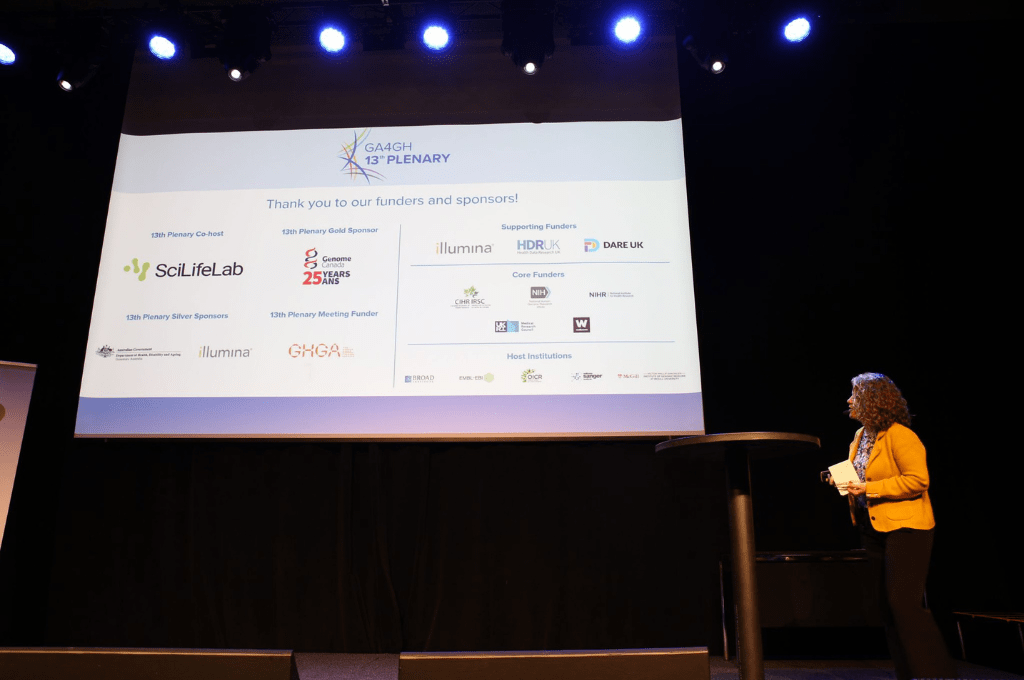
Nearly 300 members of the global genomics community gathered in Uppsala for the Global Alliance for Genomics and Health (GA4GH) 13th Plenary meeting, with another 300+ people joining online. Co‑hosted by SciLifeLab, the meeting focused on practical standards, responsible data sharing, and how multi‑omics and AI can translate discovery into patient benefit.
The first day started with a welcome speech by SciLifeLab co-director Mia Phillipson and Heidi Rehm, chair of the GA4GH Executive Committee, and professor of Pathology at Mass General Hospital and the Broad Institute. Heidi underscored how much work remains to bring clarity to patients and clinicians. “In order to most effectively support variant interpretation in patients, we need access to data from all around the world because most variants are seen in one or maybe a handful of individuals. By context today, one third of all genetic tests end in an inconclusive result due to a variant of uncertain significance.”
Building trust in data sharing
That appeal for trust and interoperability resonated with the European policy conversation threading through the week. Kjetil Taskén, Professor of Medicine at University of Oslo and a member of ScLifeLab’s International Advisory Board, noted momentum around continental frameworks and their social license. “I think it’s very interesting to see what’s happening in other parts of the world in terms of health data and health data aggregation and real-world evidence. I think it was a very nice update here on where we are with the European health data space and how that is moving forward and also how we will handle the trust issues related to that.”
Sweden’s multimodal advantage
In Sweden, much of that ambition converges at SciLifeLab, which co‑hosted the meeting. As Taskén put it, “I think Sweden, in SciLifeLab, has a fantastic infrastructure to create life science data and to analyze a number of different modalities from the health perspective.” The promise, he added, is explicitly multi‑modal, “SciLifeLab has a fantastic capacity to advance precision medicine in terms of providing multi-dimensional and multimodal data on patients. We’re talking genomics, proteomics, functional genomics and functional precision medicine for example, and that capability should be used also when precision medicine is being implemented.”
Small nations, big collaborations
The small‑nation advantage of moving quickly and partnering deeply, also came into focus. Patrick Tan, Professor at Duke-NUS Medical School Singapore and Executive Director of PRECISE, Singapore’s Precision Medicine Strategy, framed collaboration not as an abstract aspiration but as a practical operating model, especially between countries that share a bias for action. “Well, I would say that a small country like Singapore has great interest in working with other small countries like Sweden to be able to share expertise. I would say that we are both very pragmatic countries where we can start to do projects on a short-term basis, always looking towards the next development and to build further from there.”
Tan continued, “I think that these countries have a responsibility to be able to develop these programs for public benefit as well as for research insights and to catalyze new industry innovations. And this is where actually Singapore would like to work very closely with Sweden on many of these aspects.”
From advanced disease to early detection
That pragmatism extends beyond genomics to the wider “omics” stack, where nearer‑term clinical impact may come from catching disease signals earlier and more precisely. Tan was clear about the direction of travel, “So as we move more and more from the management of patients with advanced stage disease to the early sector, early symptomatologies, these multi omic approaches will be very, very important to pick up early warning signals of future disease.”
Read more about GA4GH 13th Plenary here >>
The Global Alliance for Genomics and Health (GA4GH)
GA4GH exists to accelerate progress in human health by establishing a shared global approach to the responsible, broad, and democratised use of genomic and health data.