New resource maps global variation in immune receptor genes
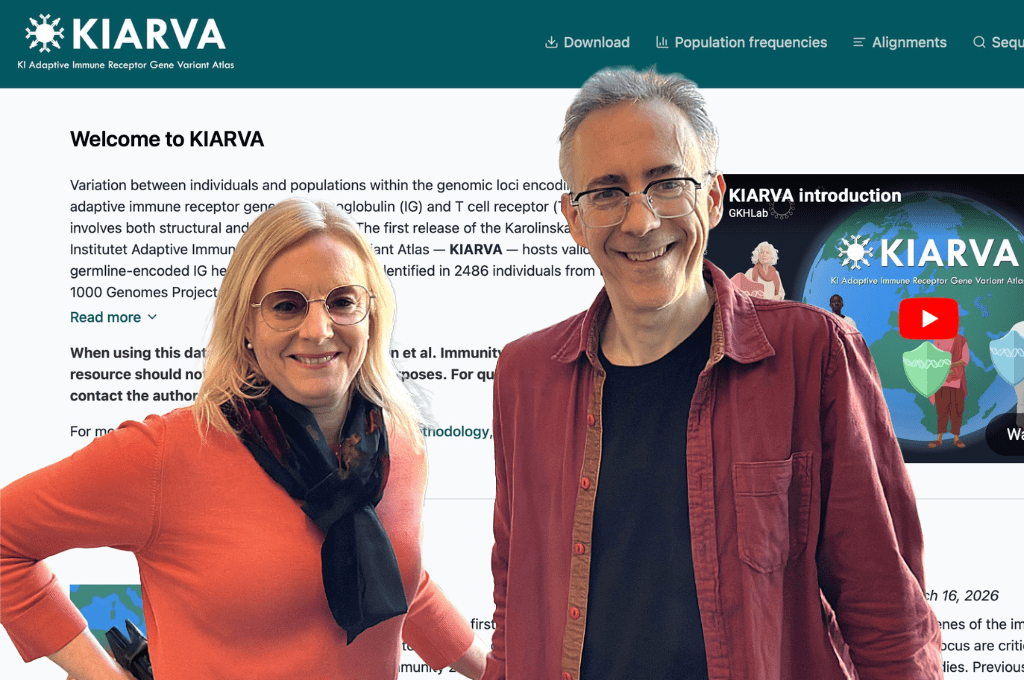
The KI Adaptive Immune Receptor Gene Variant Atlas, KIARVA, is a new open research resource hosted by SciLifeLab that maps inherited variation in adaptive immune receptor genes across global populations.
Human immune system has evolved under diverse environmental and pathogenic pressures that have varied due to geographic and climatic factors. Populations who lived thousands of years in particular regions evolved and adapted to resist pathogens endemic to these locations. Consequently, our immune genes are among the most variable in our genome, underpinning many physiological processes.
Adaptive immune responses mediated by B- and T-cells are critical for the control of infections. Antigen receptors expressed by B- and T-cells are encoded by the combinatorial assembly of about 350 variable (V), diversity (D), and joining (J) genes that reside in highly complex genomic loci. Until now, knowledge about genetic variation in these regions was limited and available reference sets were largely restricted to alleles identified in individuals of European ancestry. A population-inclusive reference set was urgently needed to facilitate immunological analysis involving individuals from around the world. However, achieving this was technically challenging since conventional sequencing methods do not provide sufficient coverage of these highly repetitive gene regions.
A method tailored for immune receptor genes
To address this challenge, Martin Corcoran, Head of Immunogenetics, and Gunilla Karlsson Hedestam, Research group leader at the Department of Microbiology, Tumor and Cell Biology (MTC) at Karolinska Institutet and SciLifeLab, and their team developed the ImmuneDiscover technique, designed to identify inherited variants in B- and T-cell receptor genes with nucleotide-precision accuracy.
The researchers then applied ImmuneDiscover to DNA samples from 2,486 individuals representing 25 population ancestries. Focusing on 50 immunoglobulin heavy-chain variable (IGHV) genes and identified 561 distinct alleles. The data collected forms the basis for the initial release of KIARVA, the Karolinska Institute Adaptive Immune Receptor Variant Atlas, described in a newly published paper in Immunity by Corcoran et al.
“Our study of the global genetic diversity in the human immunoglobulin genes provides important evidence underlying individual and population differences in immune responses to pathogens. Application of this knowledge in the years to come will help identify immune vulnerabilities to different pathogens at the individual level and facilitate the development of vaccines that work efficiently across all human populations,” says Martin Corcoran.
An open resource for the research community
KIARVA is openly available to academic researchers. The database includes downloadable germline V, D, and J allele sequences, population-specific IGHV allele frequencies across five continental groups and 25 subpopulations. The website enables sequence alignments at both nucleotide and amino acid levels. The atlas also includes a search function that allows researchers to determine whether alleles identified in their own datasets are already represented.
By providing population-resolved germline variation, KIARVA supports accurate germline gene assignment in monoclonal antibody studies and immune repertoire analyses. The resource also supports studies exploring how inherited immune gene variation influences responses to infections, vaccines, allergens, and autoimmune triggers, as illustrated in an accompanying paper by the group, also published in Immunity.
Implications for precision medicine
The researchers explain that the tool will help improve how immune-related diseases are studied.
“Ultimately, incorporation of KIARVA germline alleles into antibody and repertoire analyses will advance precision medicine approaches, for example by supporting the stratification of patients that carry gene variants associated with autoimmune diseases,” says Gunilla Karlsson Hedestam, Professor at KI and KIARVA research group leader.
Visit the KIARVA website for more information
DOI 1: 10.1016/j.immuni.2026.01.026
DOI 2: 10.1016/j.immuni.2026.03.002