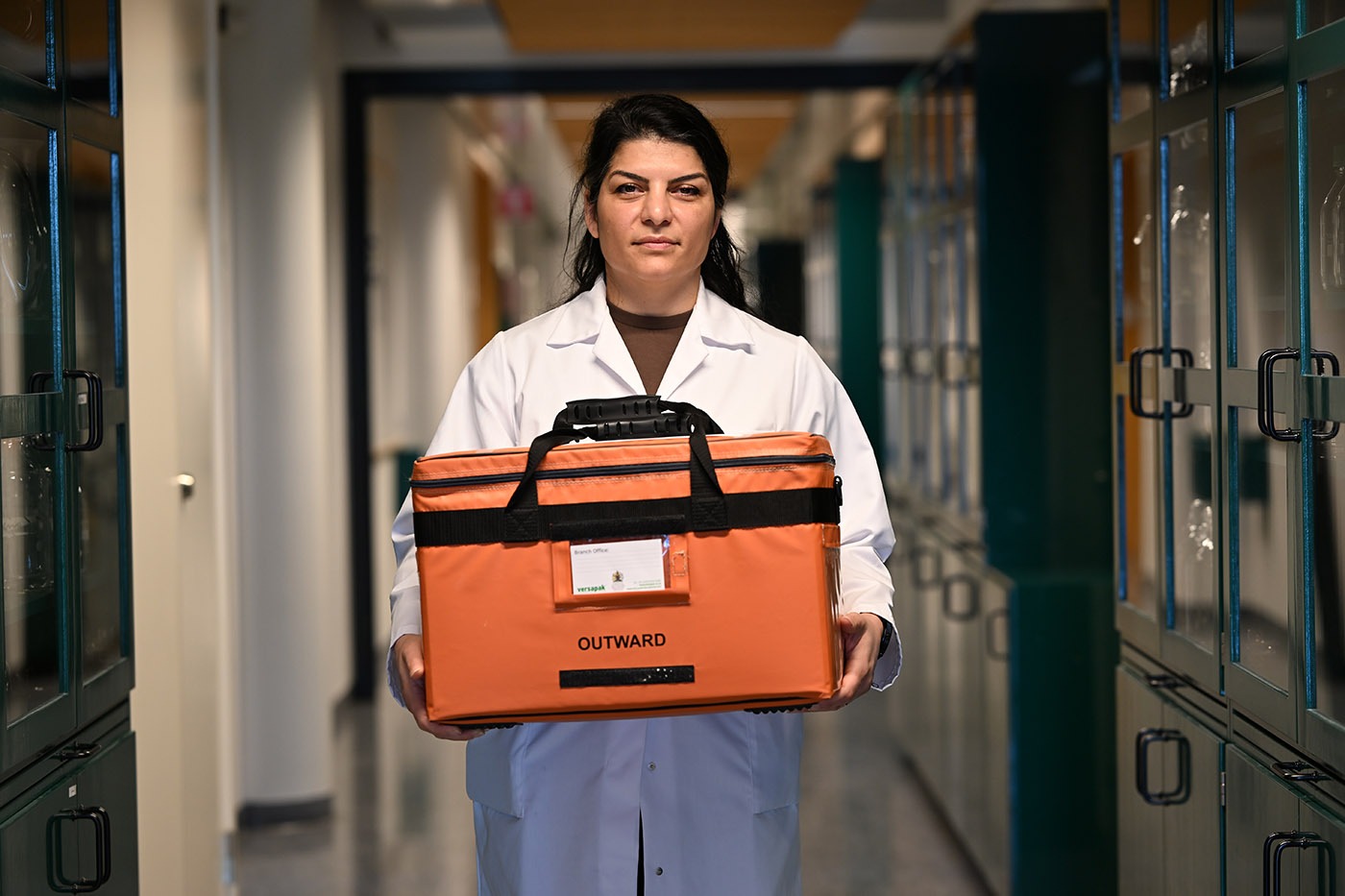

Where precision medicine begins: the sample
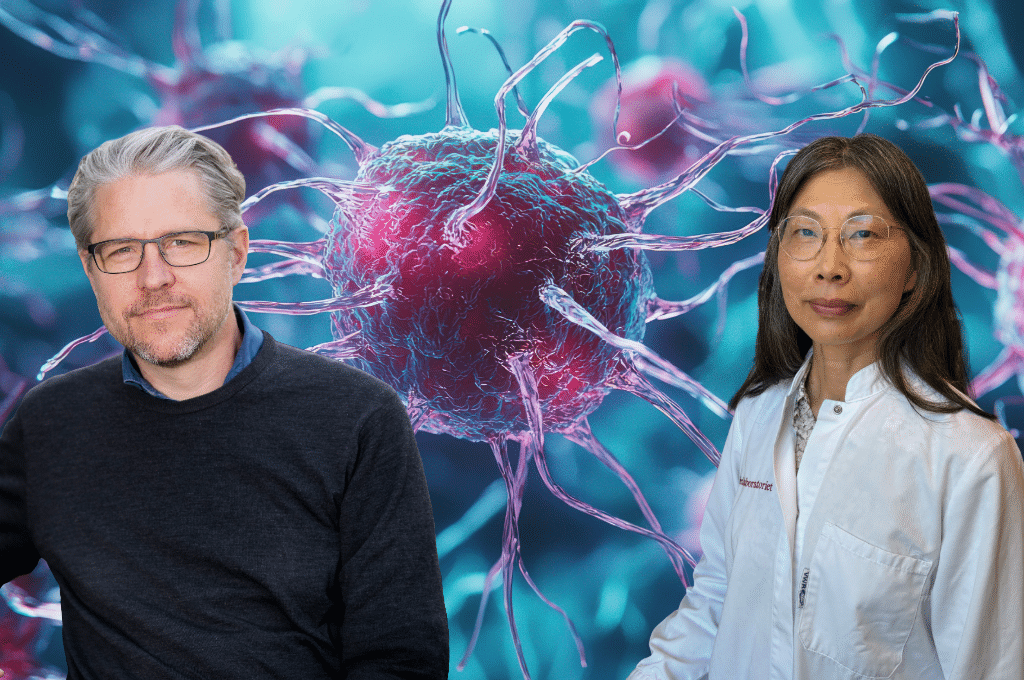
We meet with Ghazaleh Assadi, Team Coordinator at The Precision Medicine Sample Center (PMSC), a vital bridge between the clinical workflow at Karolinska University Hospital and the research infrastructure at SciLifeLab. Here, we explore how the center addresses one of the most significant barriers in modern science: sample handling.
Before a tumor can be profiled, before a protein can be measured, and before a clinician can act on molecular findings, something more basic has to happen first: the sample has to be handled correctly.
That is the part of precision medicine Ghazaleh Assadi works on every day.
Assadi holds a PhD in molecular genetics and is a team coordinator at Karolinska University Hospital, working at the Precision Medicine Sample Center at the Cancer Center in Solna. Her role sits at a critical intersection between hospital care and advanced research infrastructure.
“Our unit works hand in hand with SciLifeLab to prepare fresh clinical samples for proteomics, genomics, spatial and single-cell technologies,” the kinds of methods increasingly central to how cancer is studied and, potentially, treated. “We make sure that the hospital and the research infrastructure are fully connected, especially when it comes to handling very small biopsies and preserving viable cells for multi-omics analysis.”
In this interview, Assadi explains what happens at the sample center, how the collaboration with SciLifeLab works in practice, and why one of the biggest barriers to clinical translation is not always the technology itself, but the journey a sample takes before analysis even begins.
Q: What do you do here at the Precision Medicine Sample Center, and how do you collaborate with SciLifeLab?
“We receive fresh clinical samples directly from the hospital, and we prepare them for advanced multi-omics analysis.
We have optimized standard operating procedures specifically for clinical material and very small biopsies, and we handle the samples immediately to preserve viable cells and the molecular state. Everything we do is designed to be fully compatible with SciLifeLab technologies, and we adapt and harmonize their protocols so that each sample is multi-omics ready for proteomics, genomics, spatial and single-cell platforms.
In that sense, we act as a bridge between the clinical workflow at Karolinska Hospital and the research infrastructure at SciLifeLab.”
It is a practical description, but it also points to a broader challenge in translational medicine. Clinical care and research infrastructure often operate on different timelines, with different requirements and different constraints. A biopsy taken in the clinic may be diagnostically useful, but not automatically suitable for the kinds of high-resolution molecular analyses researchers want to perform.
Q: Can you give an example of a collaboration project that shows how this works in practice?
“One example is the PreDDLung project. We receive fresh lung cancer biopsies from Karolinska, and we process them using optimized Standard Operating Procedures (SOP) so the limited material can be used across multiple platforms.
After analysis is completed, the multi-omics results are uploaded into the Molecular Tumor Board (MTB) portal, where clinicians can review and integrate the data into patient-oriented discussions.
Our role is to make sure every biopsy is handled correctly from the very beginning, so the data that enters the MTB portal is reliable and complete.”
That example captures the center’s logic well: small pieces of clinical tissue are not simply passed onward, but actively prepared so that one limited sample can support several forms of analysis. It also shows how the work is meant to connect back to clinical discussion, not remain isolated inside a research workflow.
Q: Can you give a concrete example of where clinical proteomics has had real-world impact?
“Proteomics provides information about protein activity and drug targets that genomics alone cannot capture.
For example, in breast cancer, proteomics has been used in clinical research and decision-support settings to better understand which patients are likely to benefit from HER2-targeted therapies by measuring actual HER2 signaling activity, not just gene amplification.
We also see clear value in immunotherapy, where proteomics-based profiling of immune signaling has helped distinguish responders from non-responders in both lung and breast cancer.
These are real-world translational examples where proteomics adds decisive biological information that supports more precise treatment selections.”
It is a reminder that not all clinically relevant biology is visible at the DNA level. Genomics can show mutations and amplifications, but proteins are where much of cell signaling and drug response actually play out. That does not mean proteomics replaces genomics. It adds another layer of information — one that may be especially valuable when deciding who is likely to benefit from a specific therapy.
Still, bringing these approaches into real clinical workflows is both a scientific challenge and an operational one.
Q: What is the biggest barrier to translating this kind of cutting-edge proteomics into clinical use?
“One of the biggest barriers is sample handling. Proteomics and multi-omics require fresh, viable, and carefully prepared material, but routine hospital workflows are not built for that.
Other challenges include fragmented processes, lack of harmonized SOPs, and difficulties linking metadata and analysis results across systems.
The Precision Medicine Sample Center was created to solve exactly this gap: to provide high- quality, standardized sample preparation so that advanced proteomics and multi-omics can actually be applied in clinical studies.”
That answer shifts the focus away from the most obvious bottlenecks. The limiting factor is not always the sensitivity of an instrument or the sophistication of a computational pipeline. Sometimes it is whether the tissue arrived in time, whether it was processed consistently, and whether the metadata can travel with it in a usable way.
Q: How could a molecular medicine unit within Karolinska University Hospital improve translation and patient impact?
“A molecular medicine unit at Karolinska would have the Precision Medicine Sample Center as its key component.
The Sample Center is a natural core for such a unit because everything starts with a sample. How it is handled determines the quality of every downstream analysis. If a molecular medicine center is built around the Sample Center, then samples move seamlessly from clinics to molecular profiling, data can be integrated faster, and clinicians gain access to rich, actionable multi-omics information.
This structure would significantly accelerate the clinical impact of advanced diagnostics at Karolinska.”
By empowering breakthrough solutions in molecular life science and AI, SciLifeLab enable the rapid integration of precision medicine innovations into Sweden’s healthcare system.
Learn more about our Translation to Healthcare strategic area here.
This initiative is partly funded by the Cancer Research Foundations of Radiumhemmet.