
The Nordic advantage in plasma proteomics: from discovery signals to clinical utility
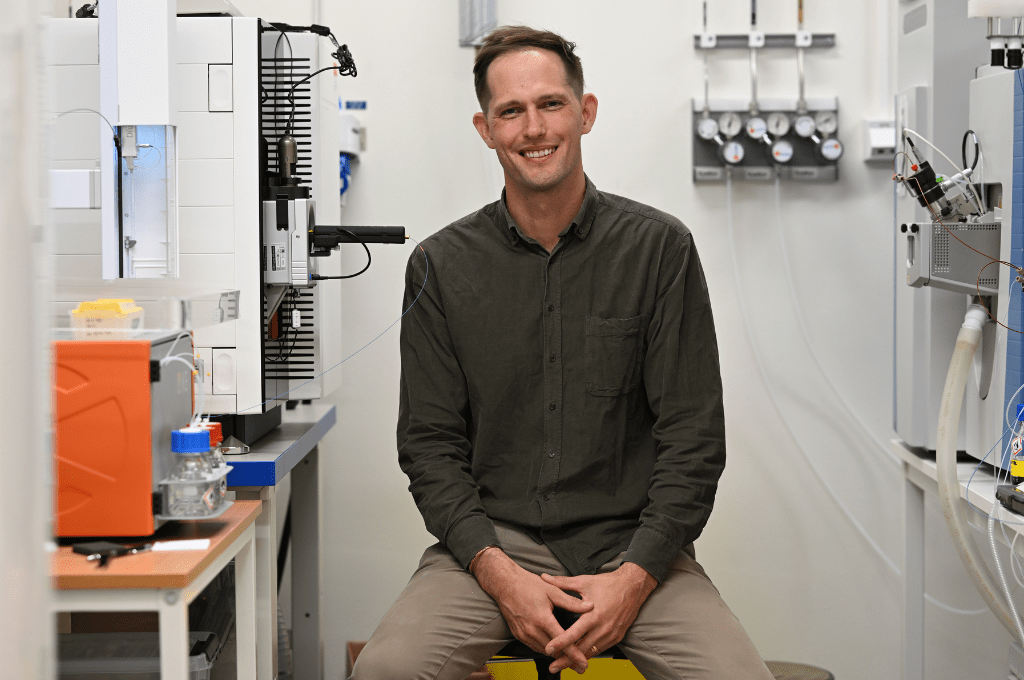
A Q&A with Fredrik Edfors, a Data-Driven Life Science (DDLS) fellow at SciLifeLab and Assistant Professor at KTH Royal Institute of Technology
Plasma contains biological information from across the body, but turning that information into clinically useful measurements remains one of the major challenges in precision medicine.
At the 3rd Norwegian Symposium on Proteomics and Biological Mass Spectrometry, organized by the National network of Advanced Proteomics Infrastructure and held at Oslo Science Park on 11–12 May 2026, we caught up with Fredrik Edfors.
In this Q&A, he discusses why plasma proteomics is moving from discovery towards clinically actionable measurements, why standardization and internal standards are essential, and how Nordic research environments are helping translate proteomics technologies into innovation.
Could you briefly introduce yourself and the scientific questions your research group works on?
My research group focuses on data-driven methods for precision medicine applications. We mainly use targeted proteomics and other proteomics technologies to profile plasma.
The central scientific question we work on is to understand which proteins are present in blood across different health states. We study the plasma proteome in healthy individuals, during ageing, and in relation to disease development. By comparing healthy and diseased blood plasma, we aim to identify early biomarkers, as well as biomarkers that can differentiate between disease states and acute clinical conditions.
What was the main message of your talk, “Towards protein-driven precision medicine using large-scale plasma proteomics”?
The main message was that plasma proteomics is now reaching a point where we can move from broad discovery signals towards clinically meaningful protein measurements.
In discovery proteomics, we often measure many proteins and generate relative signals. That is extremely valuable for hypothesis generation. But if we want proteomics to contribute to clinical decision-making, we need measurements that are interpretable, reproducible and actionable. That means absolute concentrations, reference intervals, longitudinal comparability and, eventually, decision thresholds.
This is where targeted mass spectrometry and internal standards become very important. With targeted proteomics, we can define which proteins and peptides we want to measure, use stable isotope standards, and generate quantitative ratios between endogenous proteins and standards. This helps make measurements comparable across batches, instruments, sites and time.
A key part of the message was also that standardization is the bridge between discovery proteomics and precision medicine. Quantitative Recombinant Protein Standards, or qRePS, are one example of a technology that brings protein-level internal standards into targeted proteomics workflows. Added early in the sample preparation process and measured together with the endogenous protein signal, these standards can help improve reproducibility and support absolute protein quantification. This type of standardization is important for moving from discovery signals towards robust, clinically meaningful protein measurements.
Why is plasma such an interesting, and challenging, sample type for understanding human health and disease?
Plasma is a powerful sample type because it is a proximal fluid to essentially all organs in the body. Blood has been used for centuries as a source of biomarkers, and there is therefore very important clinical information to extract from plasma.
At the same time, plasma is relatively easy to collect in clinical settings and is already used at large scale in healthcare today. That makes it very attractive if we want to develop biomarkers and measurement strategies that could eventually be implemented more broadly.
The challenge is that plasma is also a highly complex sample. It contains proteins across a very wide dynamic range, from extremely abundant proteins to low-abundance proteins that may still be clinically important. Measuring that complexity in a robust and reproducible way is technically demanding.
What is the biggest technical or biological challenge with plasma?
One of the biggest challenges is to increase the reproducibility of large-scale plasma proteomics methods. Today, many approaches are still too sensitive to batch effects and technical variation.
Plasma is also an inherently difficult sample type because of its enormous dynamic range, often spanning more than 12 orders of magnitude. At the symposium, Stefanie Hauck gave a very illustrative example: the dynamic range of proteins in blood can be compared to the size difference between a virus, around 10–100 nm in diameter and representing the lowest-abundance proteins, and Mount Everest at around 10,000 meters. This highlights just how challenging it is to capture both highly abundant and very low-abundance proteins in the same sample.
Sample preparation is a major source of variation. Every step can affect the final protein signal. That is why standardization of sampling, sample preparation, targeted assay design and data analysis is so important.
In mass spectrometry-based workflows, the introduction of proper internal standards is especially important. If standards are added early and processed together with the endogenous proteins, they can help correct for variation introduced during digestion, clean-up and LC-MS/MS analysis. This is a key reason why protein-level standards and standardized workflows are important for clinical translation.
How has your work with the Human Protein Atlas shaped the way you think about biomarker discovery and validation?
The Human Protein Atlas has introduced a large-scale, organ-wide perspective on protein biology. It provides information about where proteins are expressed across the body and in different cell types.
This makes it possible to ask where a plasma protein may originate from when we detect it in blood under a specific disease condition. In that way, the Human Protein Atlas helps connect plasma biomarker signals to tissue origin, cell types and biological context.
That perspective is important because biomarkers should not only be statistically associated with disease. We also need to understand what they represent biologically, where they come from and whether they are likely to be robust across different patient groups and clinical settings.
What is the most common misconception when moving from biomarker discovery to clinical use?
A common issue is that many studies do not have a clearly defined clinical application as their end goal. Researchers performing large-scale proteomics studies often report “potential biomarkers”, but these markers are frequently not sufficiently validated for clinical use.
There is an inflation of biomarkers in the scientific literature. More than 70,000 biomarker papers are published every year, but on average only around two biomarkers per year make it all the way to fully implemented FDA-approved clinical markers. This shows a clear discrepancy between what we identify in large-scale research studies and what is actually applicable in the clinic.
The problem is not necessarily that the biomarkers themselves are poor. It may also be that they are difficult to translate. Therefore, it is important to design studies with the final clinical application in mind and to consider whether the biomarker will still perform under real clinical conditions, which are often less controlled than research studies.
What were your impressions of the symposium in Oslo?
My impression of the symposium was very positive. It had a strong scientific programme and many excellent speakers, spanning clinical omics, spatial omics, plasma proteomics, mass spectrometry and translation towards innovation and clinical impact.
It was particularly interesting to see the momentum in Norway around proteomics and biological mass spectrometry. The establishment of stronger national infrastructure and coordinated proteomics capabilities is very important. It can make advanced proteomics technologies more accessible to researchers and clinicians across the country.
One of the most interesting aspects was to see how plasma proteomics is being run at large scale in both Germany and Denmark. There were two talks that stood out to me: one focused on discovery and diagnostics, showing how plasma proteomics is being used at scale in Denmark to support diagnostic development and biomarker discovery; the other focused on large-scale reproducibility studies in Germany, including work from the Helmholtz environment, where thousands of samples are analyzed across leading proteomics laboratories using both Olink and discovery mass spectrometry.
What is the state of the Nordic proteomics ecosystem more broadly?
I would describe the Nordic proteomics ecosystem as very strong. The Nordic countries are major contributors to the field and have excellent national infrastructures with high capacity to run many different proteomics platforms.
This includes affinity-based proteomics, targeted proteomics, mass spectrometry-based proteomics, spatial proteomics and proteomics applied not only to blood, but also to cells, tissues and other sample types. These technologies can be combined with the high-quality biobanks available in the Nordic countries.
The Nordic countries have also been very good at collecting, categorising and following human biological material and disease cohorts over long periods of time. This creates a potential goldmine for future precision medicine.
Another strength is the innovation ecosystem. The region has generated companies and technologies across different parts of the proteomics value chain. Examples include Olink Proteomics in affinity-based plasma proteomics,ProteomEdge in qRePS-based targeted absolute protein quantification, and Evosep in LC-MS sample preparation and separation workflows. I am part of the scientific co-founder team behind ProteomEdge, which is one example of how methods developed in academic environments such as KTH, SciLifeLab and the Human Protein Atlas can be translated into tools for broader research use.
Do you currently collaborate with researchers or institutions in Norway — or do you see opportunities for closer collaboration?
We have already established research collaborations with the University of Tromsø. We are helping with the analysis of samples and are planning to analyze samples from the Tromsø Study.
Since the aim is to assess cardiovascular risk, we are considering ApoEdge, which covers the full apolipoprotein panel, combined with genotyping of the LPA Kringle IV repeat region. This is relevant because variation in the LPA gene, particularly the number of kringle IV type 2 repeats, is linked to lipoprotein(a) levels and cardiovascular risk. This is something that targeted mass spectrometry can quantify directly, giving the technology a clear advantage over other available analytical platforms.
More broadly, I see many opportunities for closer Nordic collaboration in plasma proteomics. Norway has strong clinical cohorts, excellent research environments and increasing infrastructure in proteomics and mass spectrometry. Combining these strengths with large-scale proteomics workflows and Nordic biobank expertise could be very powerful.
What developments in plasma proteomics are you most excited about?
I am particularly interested in seeing how these technologies can be introduced at larger scale within healthcare. I am currently working with Region Stockholm and Karolinska University Hospital to explore how this could be implemented more directly.
The hope is that plasma proteomics, large-scale proteomics and machine learning methods together can provide more definitive answers that support better-informed clinical decision-making.
A key challenge is the time from blood sample to analytical result. I hope this time aspect can be solved in the near future. I believe that the connection between affinity-based proteomics and mass spectrometry-based proteomics will be central here.
Overall, I think there are strong reasons to believe that plasma proteomics can become an important method for precision medicine and future healthcare.