Research Interest
Hannebelle Lab – In-vivo-mimetic systems to study the physics of infection
The Hannebelle Lab studies the physical mechanisms that allow pathogens to move, adhere, invade, and spread through host environments.
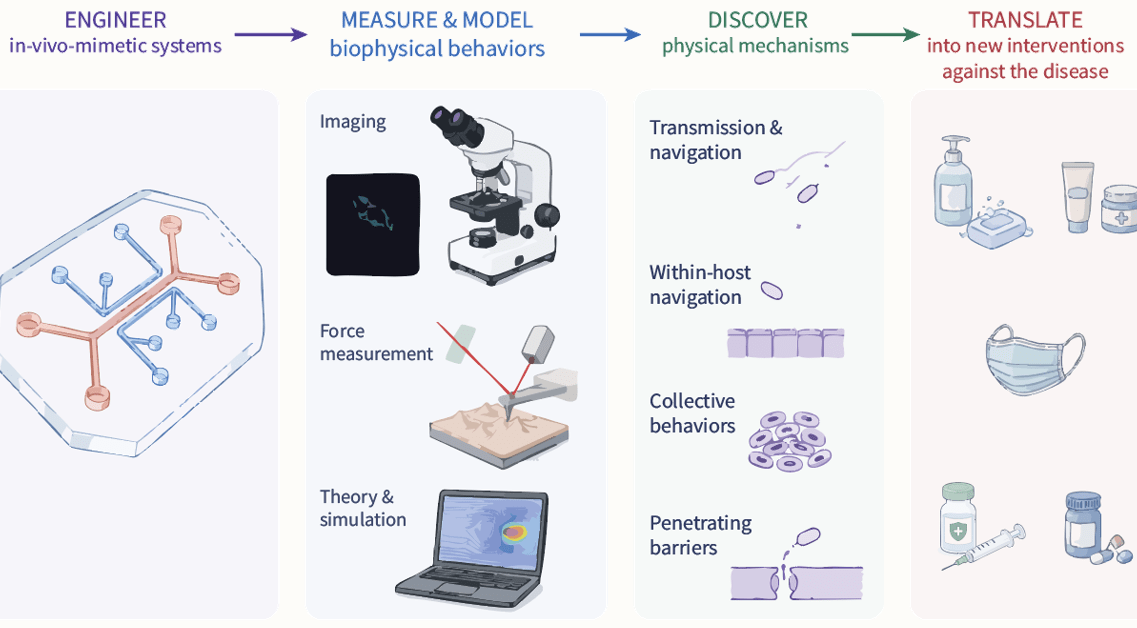
We are a multidisciplinary research group based at KTH Royal Institute of Technology and SciLifeLab in Stockholm. Our work combines biophysics, engineering, quantitative microscopy, microfluidics, and biological models to understand infection as a physical process as well as a molecular one.
Molecular and physical mechanisms of infection
Infectious disease is often understood through its molecular components: pathogens, host receptors, immune responses, drugs, and vaccines. But infection also depends on physical steps. Pathogens must swim or move, attach to surfaces, withstand flows and forces, cross barriers, and navigate complex tissues.
We study these overlooked physical mechanisms to identify bottlenecks in infection. By understanding how pathogens interact mechanically and dynamically with their environments, we aim to reveal new ways to interfere with infection processes.
In-vivo-mimetic systems
We build experimental systems that reproduce selected features of host environments in the laboratory. These include microfluidic devices, organs-on-a-chip, and tissue-like environments where physical parameters such as flow, confinement, adhesion, and mechanical resistance can be controlled.
These systems allow us to isolate and measure physical processes that are difficult to access in living hosts, while keeping the biological questions closely connected to infection.
Quantitative biophysics of pathogens
The lab uses microscopy, force measurements, modelling, and simulation to quantify how pathogens move and interact with their surroundings. We are interested in processes such as motility, adhesion, collective organization, tissue invasion, and barrier crossing.
Our long-term goal is to understand infection across scales, from the motion and mechanics of individual pathogens to their behavior in host-like environments.
Research vision
By treating infection as both a biological and physical process, we seek to complement existing molecular approaches to infectious disease. Our hope is that uncovering the physics of infection will point to new strategies for prevention, diagnosis, and intervention.