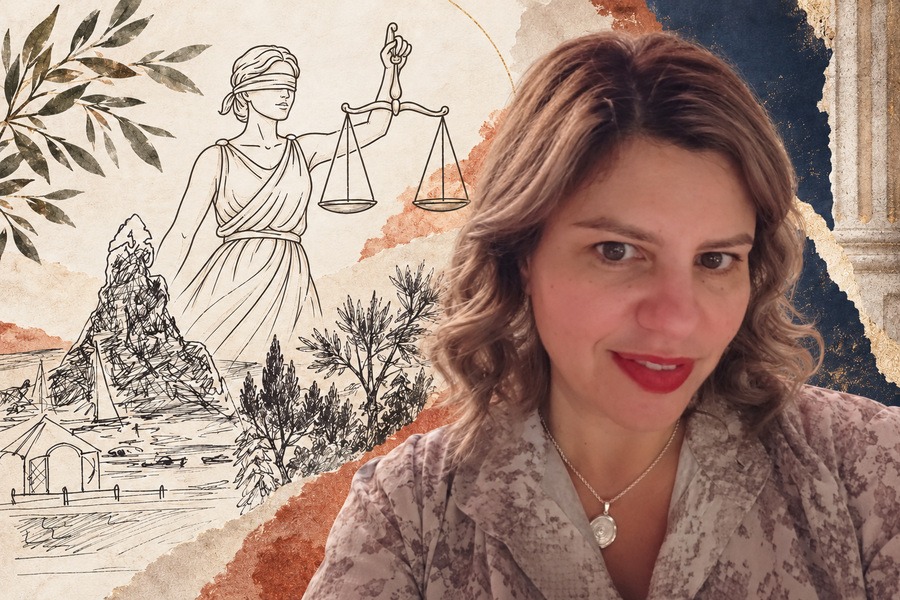

SciLifeLab Voices: Frantzeska Papadopoulou Skarp
We got a chance to check in with Frantzeska Papadopoulou Skarp, professor of private law at Stockholm University to hear about her work as part of the SciLifeLab Industry Access project, her thoughts on good industry access to research infrastructures, and what the poem Ithaka can tell us about our journey through life.
Hello, Frantzeska, tell us a bit about yourself!
I am a professor of private law at Stockholm University, specialising in intellectual property law. My research has always been quite interdisciplinary and often sits at the intersection between law, science and technology. Over the years, I have worked extensively with questions concerning biotechnology, genetic resources, pharmaceutical products, and increasingly with research data, AI and precision medicine.
I am also affiliated with KI AI Innovation Center, the Center for Precision Medicine at Karolinska University Hospital as well as the Karolinska Comprehensive Cancer Center. That has brought me even closer to the practical legal questions that arise when research, healthcare, infrastructure and industry meet. What interests me most is often not law in isolation, but how legal rules actually shape what scientists and other actors can do — and how we can design legal frameworks that enable collaboration while protecting the interests that genuinely need protection.
You are engaged as legal expert in the SciLifeLab industry access project, what have you been focusing on?
My main focus has been on understanding what happens (from a legal perspective) when a company wants to access and use SciLifeLab infrastructure. SciLifeLab is particularly interesting because it is a national infrastructure, but its facilities are embedded in different universities and organizations, each operating within its own legal and administrative environment.
I have initially spent a lot of time listening. Through interviews and workshops with people working across the infrastructure, we have tried to identify where the actual legal difficulties arise in practice, which bottlenecks can be identified and which hinders are merely hypothetical.
A central part of my work has been looking at contractual agreements: what kind of relationship is created when industry accesses an infrastructure, which terms are really necessary, and where could we develop more common approaches between universities that are part of the ScilLifeLab? The ambition is not simply to produce more legal documents. Quite the opposite: it is to see whether law can make access easier, faster and more predictable.
What are the main legal questions that arise when a company wants to use SciLifeLab infrastructure?
There are several, and they are interconnected. One of the first questions is simply: what is the relationship? Is the company purchasing a service, entering into a research collaboration, accessing equipment or expertise, or some combination of these? That classification matters because different legal consequences follow.
Then come questions about confidentiality, intellectual property, research results and data: Who owns what? What may the company do with the results? What can the university or infrastructure continue to use for research? Can results be published? How should confidential information be handled?
Due to the fact that SciLifeLab is distributed across several host organisations, we also encounter a very practical question: how can access feel coherent to the company when the legal organisation behind the infrastructure is decentralised?
One of our conclusions is that many of these questions are not individually unusual. The difficulty comes from having to solve them repeatedly, sometimes differently, across a distributed infrastructure.
Looking beyond this project, what would good industry access to Swedish research infrastructure look like to you?
For me, good industry access would be simple without being legally simplistic.
A company should be able to understand where to go, what it can access, approximately what it will cost, what conditions apply and how long the process will take. It should not have to understand the internal organisational structure of Swedish universities in order to access an infrastructure.
At the same time, universities and infrastructures need to safeguard academic freedom, public resources, research data, intellectual property and their ability to conduct future research. Good access therefore does not mean removing the legal framework; it means making it proportionate, predictable and understandable. In this respect I also think it is particularly important to provide a framework that allows Industry Access that does not require endless hours in negotiations for platform directors and unit heads, and one that does not block unnecessarily too much time from the legal departments of the respective universities.
Ultimately, I would like to see a more coordinated Swedish approach, with shared principles, processes and contractual solutions where that is possible. Sweden has extraordinary research infrastructure. The legal and administrative pathways into it should be just as good.
5. What are you currently reading?
I am currently reading Land by Maggie O’Farrell, the author of Hamnet. I find it fascinating because of the questions it raises about identity, belonging and our relationship to place. How much of who we are is connected to where we come from? What does it mean to belong to a particular place, and what happens to that connection when people leave, borders change or places themselves are redefined? These are questions I find myself returning to also as a lawyer — although I promise I don’t only read novels looking for legal questions!
6. What was the last movie that really touched you, and why?
The last film that really touched me was Odysseus by Christopher Nolan. Perhaps partly because I am Greek and grew up with these stories, but mainly because the Odyssey says something so universal about the many different struggles, we have to face in order to find our way home — and about how much we ourselves have changed by the time we finally arrive.
It also made me think of one of my favorite Greek poets, C. P. Cavafy, and his poem Ithaka. He tells us that when we set out for Ithaka, we should wish for the journey to be long, full of obstacles and of adventures. I love that idea. We are so often focused on arriving somewhere, achieving a goal, while it may be everything that happens along the way — the difficulties, discoveries, detours and people we encounter — that actually makes us who we are. And perhaps when we finally reach “home”, we understand both home and ourselves differently.
No budget or practical constraints attached – where would you like to travel – and with whom?
This is almost an impossible question! I love to travel and I honestly have a thousand places I want to visit, most of them far, far away.
But right now, I would choose Cairo, because I would really like to visit the new Grand Egyptian Museum. It looks extraordinary, and for a history nerd like me, having so much of ancient Egyptian history brought together in one place sounds irresistible. I could probably disappear into that museum for days.
And I would go with my family. There is something very special about discovering a place together — although I suspect they might eventually have to drag me out of the museum!