When every hypothesis is published: AI and the exploitation of Open Science Assets
October 27, 2026 @ 11:00 – 12:00 CET
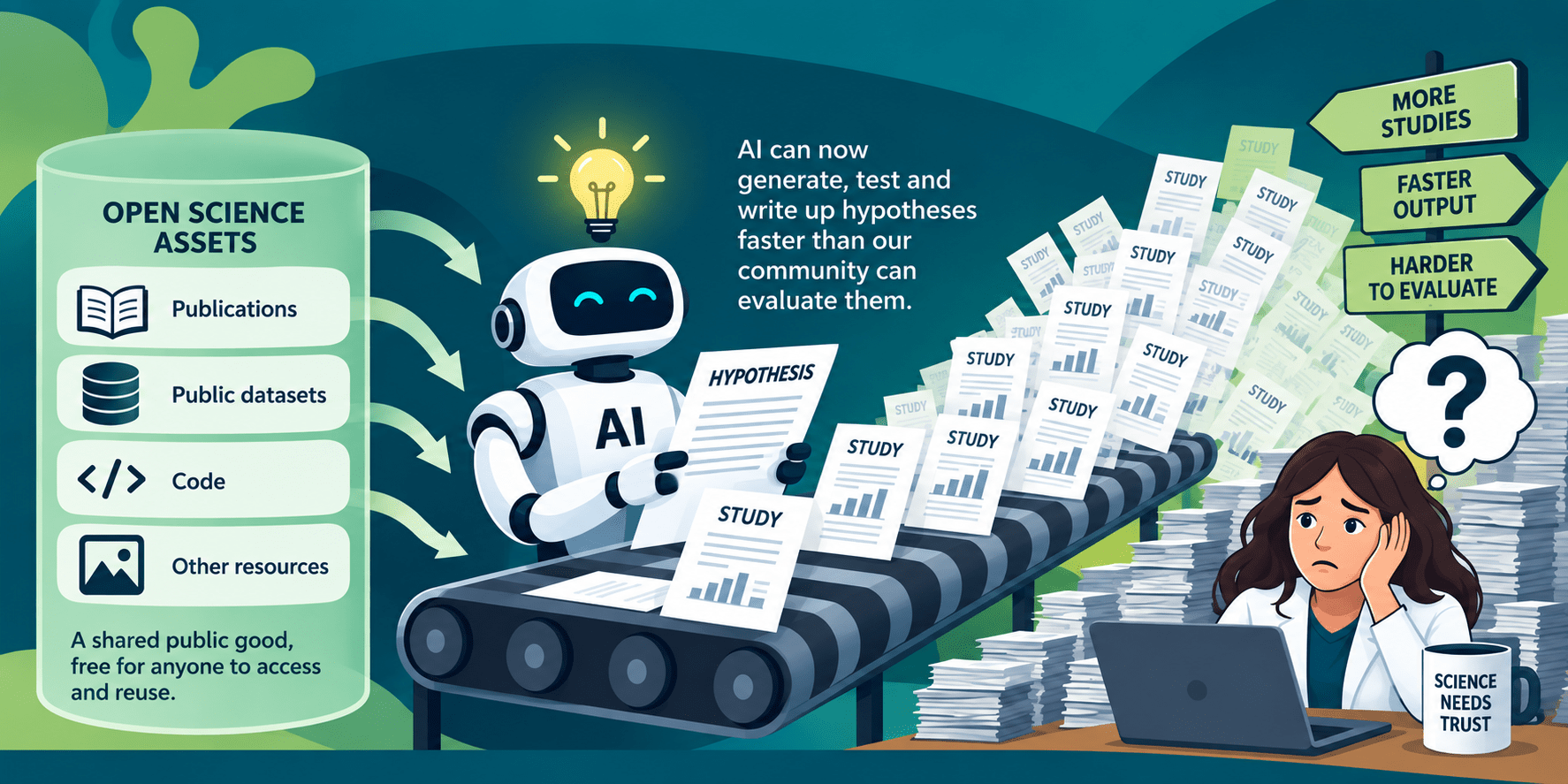
Open science has given us a shared public good, in the form of publications and public datasets, free to access and reuse by anyone. But AI can now generate, test and write up hypotheses against those assets faster than our community can evaluate them. This seminar looks at what happens to open repositories when they become inputs to industrial-scale hypothesis generation. We will also provide case studies of outputs that can be generated in under an hour, and examples of the impact on the literature (including the de facto banning of some open science resources altogether). It also asks what data stewards, funders and publishers can realistically do about it.
Presenters:
Matt Spick Institute for People-Centred AI, University of Surrey, UK
Matt Spick is a Lecturer in Health and Biomedical Data Analytics at the University of Surrey and a member of the Institute for People-Centred AI. His research focuses on AI, research integrity, Open Science and the detection of problematic scientific publishing.
Danny Maupin School of Health Sciences, University of Surrey, UK
Danny Maupin is a Research Fellow in Health Data Sciences at the University of Surrey. His research spans digital health, AI and research integrity, including how generative AI is changing research practices and the use of Open Science resources.
The session will conclude with an open Q&A, providing an opportunity to ask questions and interact with presenters.
More Information
This event is part of the SciLifeLab Open Science seminar series, an event series by the SciLifeLab Data Centre and NBIS joint Data Management team.
The goal of the events in this seminar series is to provide interesting interactive seminars around topics related to Research Data Management and Open Science in general, and to foster discussions around best practices.
Research Data Management (RDM) concerns the organization, storage, preservation, and sharing of data that is collected and analyzed during a research project. Proper planning and management of research data will make project management easier and more efficient while projects are being performed. It also facilitates sharing and allows others to validate as well as reuse the data.
Open Science is a set of principles and practices that aim to make scientific research from all fields accessible to everyone for the benefits of scientists and society as a whole. Open science is about making sure not only that scientific knowledge is accessible but also that the production of that knowledge itself is inclusive, equitable and sustainable.
The events are open to everyone working at or affiliated with a Swedish research institute or university. We welcome all researchers, educational professionals, staff, RDM professionals, and others with an interest in life sciences, from all university levels. The events are informal and inclusive, so feel welcome to join and participate in our interesting discussions!
The events will be recorded and published openly after the seminars on the SciLifeLab YouTube channel. The slides will be made available at our SciLifeLab Data Repository.
More information about SciLifeLab Data Centre and NBIS joint Open Science seminar series: https://www.scilifelab.se/data/scilifelab-data-management-seminar-series/
If you have suggestions for topics or presentations, please contact us at data-management@scilifelab.se
For more information or inquiries, please contact us at data-management@scilifelab.se
 Google Calendar
  iCalendar