
Under stress, bacterial RNA and proteins tell different stories
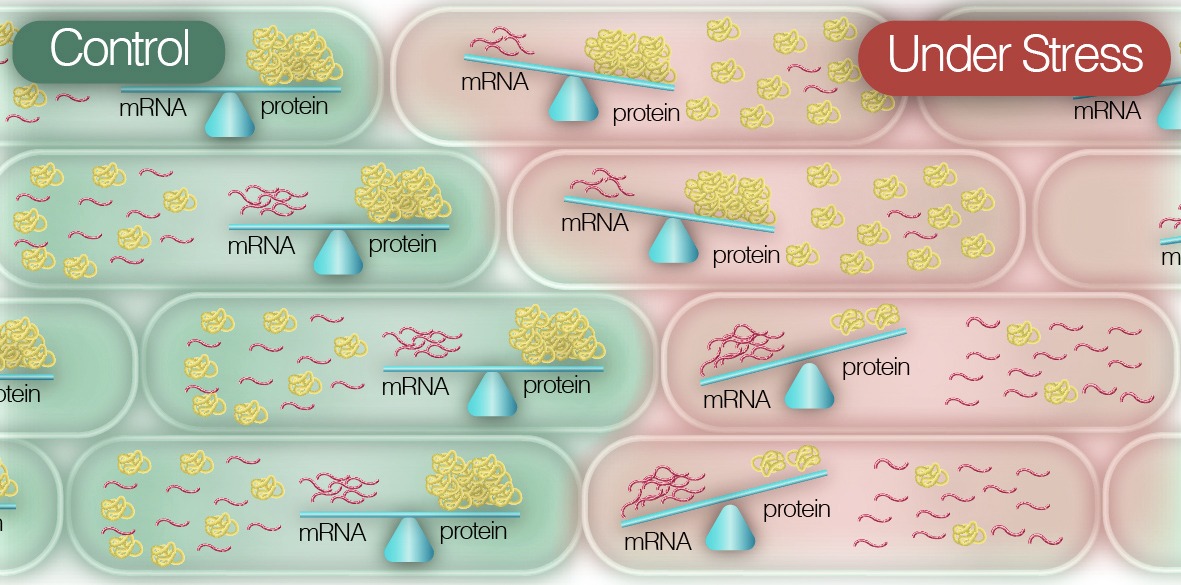
When bacteria come under stress, changes in their RNA do not always tell the same story as the proteins they produce. Researchers at SciLifeLab, IceLab and Umeå University have now compared RNA and protein levels in three human bacterial pathogens exposed to ten different stresses. In a study published in Proceedings of the National Academy of Sciences (PNAS), they found that the two became less closely matched as the bacteria mounted stronger stress responses. Under osmotic stress, they went on to show experimentally that protein production was reduced.
Messenger RNA, or mRNA, carries information from genes that can then be translated into proteins. Measuring mRNA has become a powerful way to see how bacteria respond to changing environments. But proteins carry out much of the work of that response, and their levels are also shaped by what happens after an RNA message has been produced.
Scientists already knew that mRNA levels do not perfectly predict protein abundance. What has been less clear is how that relationship changes across different stresses and pathogens, and what might be happening inside the cell when the mismatch becomes particularly strong.
The researchers compared Salmonella enterica Typhimurium, Yersinia pseudotuberculosis and Staphylococcus aureus. While Salmonella and Yersinia share some similarities, Staphylococcus is quite different. All three, however, encounter some of the same types of stress during infection. By comparing them under ten infection-relevant conditions, the researchers could investigate whether changes in the relationship between mRNA and proteins were particular to one pathogen or appeared more broadly.
“By looking at several pathogens with different physiology, we could identify both shared patterns and species-specific responses,” says Sena Gizem Süer, shared first author of the study. “That allowed us to see what was more broadly relevant, while still capturing differences in how bacteria handle stress.”
Kemal Avican, senior author of the study and a SciLifeLab Group Leader, has long been interested in how bacteria adapt to the stressful environments they encounter during infection.
“My research focuses on how bacteria adapt to stressful infection environments using transcriptomics,” he says. “Since proteins are the final products of most genes, we wanted to know how closely mRNA levels correlate with protein levels, an area of biology that remains relatively understudied.”
When the message and the response diverge
Across all three bacteria, mRNA and protein levels generally tracked one another. When mRNA increased or decreased, so did protein levels. How closely they matched, however, depended on the conditions the bacteria encountered.
Conditions that triggered larger changes in gene and protein expression also tended to show a weaker match between mRNA and protein levels. In other words, some of the conditions in which bacteria were making their biggest adjustments were also those in which RNA gave a less complete picture of what was happening at the protein level.
“We found that mRNA and protein levels do not always correlate, especially when cells are under stress,” says Avican. “When we investigated why, we discovered that under osmotic stress, translation efficiency did not match the amount of mRNA being produced. This means that measuring mRNA alone may not always provide an accurate picture of the proteins that are ultimately made.”
One stress condition in particular gave the researchers something to investigate more closely: osmotic stress.
A signal from osmotic stress
Osmotic stress occurs when changes in the concentration of dissolved substances around a cell disturb its water balance. Pathogens can encounter high-osmolarity environments in the body, for example in the gut lumen.
Among genes responding specifically to this stress, the researchers found a particularly weak match between mRNA and protein levels across all three bacterial species.
To investigate the pattern further, the researchers turned to MOBILE, a computational method developed by study co-author Cemal Erdem, a DDLS Fellow at Umeå University, and colleagues. The method was initially developed using cancer data. Applied here to bacterial data, MOBILE pointed towards translation, the process in which ribosomes read mRNA and build proteins, as behaving unusually under osmotic stress in Yersinia pseudotuberculosis.
“MOBILE pointed us towards translation as something unusual under osmotic stress in Yersinia,” says Jérôme Arnoux, co-first author of the study. “We could then go back to the lab and test that experimentally.”
The study brought together expertise from several research groups at SciLifeLab and Umeå University. Avican’s group contributed expertise in bacterial stress responses and transcriptomics, while André Mateus’ SciLifeLab group generated the proteomics data. Erdem, a DDLS Fellow, contributed the computational analysis that helped identify the changes in translation.

The researchers then tested the computational finding experimentally. They found that bacteria continued to translate mRNA into proteins under osmotic stress, but at a significantly reduced level in both Yersinia and Salmonella.
“One of the most exciting parts of the study was generating the proteomics data together with André Mateus’ lab and seeing the MOBILE results from Cemal Erdem’s group,” says Avican. “It was also surprising to see the puromycin assay results under osmotic stress in both Yersinia and Salmonella, which confirmed what we had observed in our analyses.”
Exactly why translation slows remains unresolved. The researchers discuss several possibilities, including changes affecting the cell envelope and the transport of molecules into the cell, but the current experiments cannot distinguish between the mechanisms involved.
A broader resource for studying bacterial stress
Beyond the osmotic-stress experiments, the study provides a broader resource: paired RNA and protein measurements for three pathogens across ten infection-relevant stress conditions. The dataset can be used to investigate when RNA can reliably predict protein abundance, including under stress conditions where the relationship between the two changes substantially.
“Researchers often use mRNA as a proxy for what is happening at the protein level. Our results show that we need to better understand the uncertainty in that relationship, particularly when studying bacterial pathogens under stress and during infection,” says Avican.
The researchers are now extending the work to additional stress conditions that resemble environments bacteria encounter during infection. Arnoux is continuing this research as an IceLab Interdisciplinary Postdoctoral Fellow.
“The next step is to test the same question under multiple stress conditions that we believe resemble the infection environment,” says Avican. “Our ultimate goal is to predict bacterial protein levels during infection, something that is not currently feasible using proteomics approaches alone.”
Read our interview with DDLS Fellow Cemal Erdem
Written by Gabrielle Beans Picón, reviewed and revised by a SciLifeLab editor.