
From tropical ecology to human health: researchers meet at DDLS Annual Conference
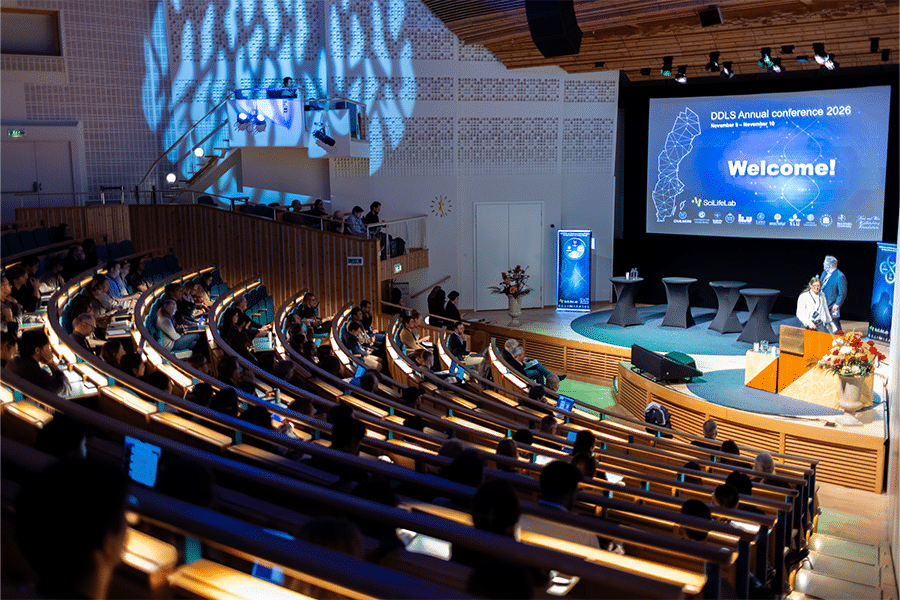
The SciLifeLab & Wallenberg National Program for Data-Driven Life Science (DDLS) supports the paradigm shift towards data-driven research that uses data, computational methods and AI to understand biology, human health and ecosystems. Through recruitment of research group leaders, education, training and data services, the program is building expertise in data-driven life science across Sweden. At the 5th DDLS Annual Conference, over 300 researchers met to discuss science and share experiences.
“We are now six years into the program where a total of 50 DDLS Fellows will join. Today, 43 of those have already started their research or recently accepted positions at the elven partner organizations. As the program matures, we are looking forward to launching the DDLS Alumni program in 2027, as a way to keep this strong network to leverage data-driven life science research”, said Heidi Törmänen Persson, DDLS program coordinator.
The DDLS Program has four strategic research areas: Epidemiology & Biology of infection; Cell and molecular biology; Evolution and biodiversity; and Precision medicine and diagnostics. During the annual conference, keynote speakers, DDLS Fellows and poster presenters gave a comprehensive overview of the field of data-driven life sciences today and a glimpse into the future.
“The DDLS Fellows bring new expertise and ideas to life science research, and by supporting them as independent group leaders and creating opportunities to collaborate across disciplines and universities, we can achieve more than any group could on its own. One amazing thing with this meeting is to hear how people from other fields approach their research questions. We work on very different problems, but often share methods and challenges. Meeting and discussing our work helps us learn from each other and find opportunities to collaborate,” says Carolina Wählby, DDLS Co-Director and moderator at the conference.
Four recently recruited fellows discussed how data-driven life science can help answer complex biological questions, from understanding genetic variation and drug response to studying infection and the effects of transposable elements. They emphasized the value of collaboration across disciplines, the potential long-term benefits for patients, and the challenges of building new research groups.
Asked what they would pursue with unlimited resources, Johannes Cairns envisioned “AlphaInfection,” a predictive model of pathogens, microbiota and host interactions, particularly in the context of treatment. Tobias Baril, meanwhile, said he would “sequence everything, every eukaryote” and bring the data together to investigate how transposable elements shape the tree of life.
To conduct data-driven research in the field of ecology, real world observations are needed. However, for many tropical species, such information is lacking. Sille Holm, researcher in DDLS Fellow Mariana P. Braga’s group at the Swedish University of Agricultural Sciences in Uppsala focuses on the interactions between butterfly caterpillars and their host plants in Brazil and has conducted field studies in the Atlantic Forest and presented a poster at the meeting. The members of the Evolving Networks Lab search for butterfly eggs and caterpillars on vegetation and rear them to adult butterflies to study the interactions between the insects and their host plants. These rearings provide data needed to study ecological interactions, coevolution of species and understand global biodiversity patterns. As tropical forests disappear, documenting these little-known relationships becomes increasingly urgent.
“Many tropical species and their interactions remain ecological ghosts, still hidden from science. In our lab we use phylogenetically informed modeling to predict the interactions, test these interactions under laboratory conditions, and use field data to validate the interactions. The only way to bring these ghosts into the light is to spend time in the field, studying species in their most wonderful forms and recording the interactions that define their lives. Before we run out of time and possibility to study these species.”
In conjunction with the annual conference, satellite meetings and workshops on topics related to data-driven life science were arranged. As part of these meetings, the DDLS Research School arranged dedicated welcome and information sessions for newly recruited first-year PhD students and newly recruited postdoctoral researchers.
The PhD student session provided an introduction to the DDLS Research School, its structure and expectations, while senior PhD students and the PhD Council members shared their experiences and insights. A separate session welcomed newly recruited postdoctoral researchers, introducing them to the research school and providing an opportunity to raise questions and exchange experiences.
From field observations in tropical forests to computational studies of human disease, the conference illustrated the breadth of research within DDLS. It also gave researchers working on different questions time to exchange ideas, discuss shared challenges and explore collaborations, and to grow connections that will help shape tomorrow’s data-driven life science.