
Three SciLifeLab experts call for national action on open science in Curie
Ten years in, Sweden’s open science ambitions still haven’t reached researchers’ everyday work. A new debate article argues it’s time to deliver.
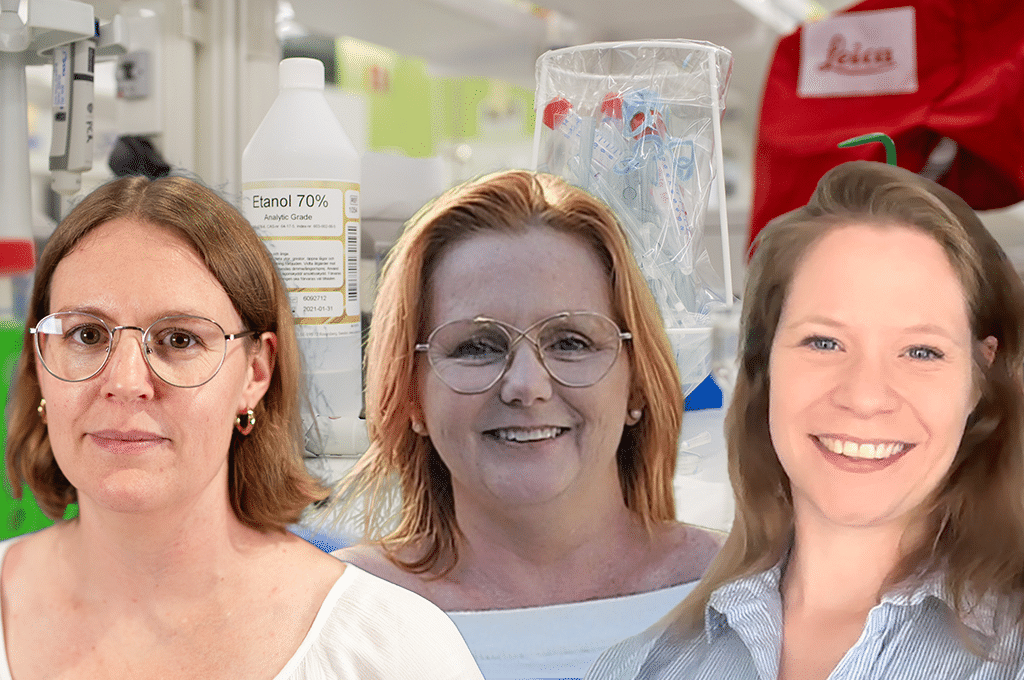
Three SciLifeLab experts, Elin Kronander (Head of Unit, Data Management, NBIS), Ineke Luijten (Scientific Training Officer, SciLifeLab Training Hub) and Jessica Lindvall (Deputy Head of Node ELIXIR-SE, Head of Training Hub and Director on the EOSC Association Board), have co-authored an opinion piece in the Swedish magazine Tidningen Curie. The article, “Tio år av löften om öppen vetenskap – när ska Sverige leverera?” (“Ten years of promises on open science – when will Sweden deliver?”), was written with colleagues from Stockholm University, Uppsala University and the Swedish National Data Service (SND).
It builds on the paper Striving for Open Science compliance in Sweden: Achieved goals and remaining challenges (Nordic Perspectives on Open Science, 2026). Its analysis of the yearly SUHF surveys (2023–2025) shows that Sweden is unlikely to reach the 2026 target for open research data.
The authors argue that the problem is not a lack of ambition. Strategies, policies and roadmaps exist, but their effect on everyday research remains limited. Only 35% of higher education institutions report having implemented data management plans for research projects, and it is hard to demonstrate measurable increases in open and FAIR data sharing. Researchers also lack incentives, as reform principles are not yet embedded in promotion and reward systems. At the root are fragmented governance and uneven development of open science infrastructures.
The article also places open science in a European context. Open science, FAIR data and EOSC are now part of the European research landscape, and researchers based in Sweden risk falling behind in collaborations and funding calls if Sweden does not build capacity and coordination at the same pace.
SciLifeLab is in a unique position to help drive this transition.
As a national research infrastructure, it is expected to develop support functions and infrastructures for open science, and to integrate FAIR data into research management, training and evaluation. SciLifeLab already contributes through training, community-building and the implementation of FAIR principles in life sciences. Its platforms work directly with researchers every day, which makes it well placed to push the cultural shift needed for open science to become the norm.
“Policies and data management plans are important first steps, but they don’t make data FAIR on their own. Researchers need hands-on support, training and time, and that requires dedicated long-term resources,” says Elin Kronander (NBIS).
Ineke Luijten (SciLifeLab Training Hub) adds: “The data show exactly where the gap is: open science skills are scarce across the research community. If the next generation of researchers is to work openly by default, training has to be built into all levels of education.”
Jessica Lindvall (Training Hub and NBIS) concludes: “National research infrastructures sit closest to the researchers who generate the data. That is where open science either works or doesn’t. We can turn policy into practice by providing FAIR-ready tools, domain-specific standards, hands-on support and training, so that sharing and reuse of data becomes part of the normal workflow rather than extra work.”
Read the article in Curie: https://www.tidningencurie.se/debatt/tio-ar-av-loften-om-oppen-vetenskap—nar-ska-sverige-leverera
Read the underlying paper: https://doi.org/10.7557/11.8391