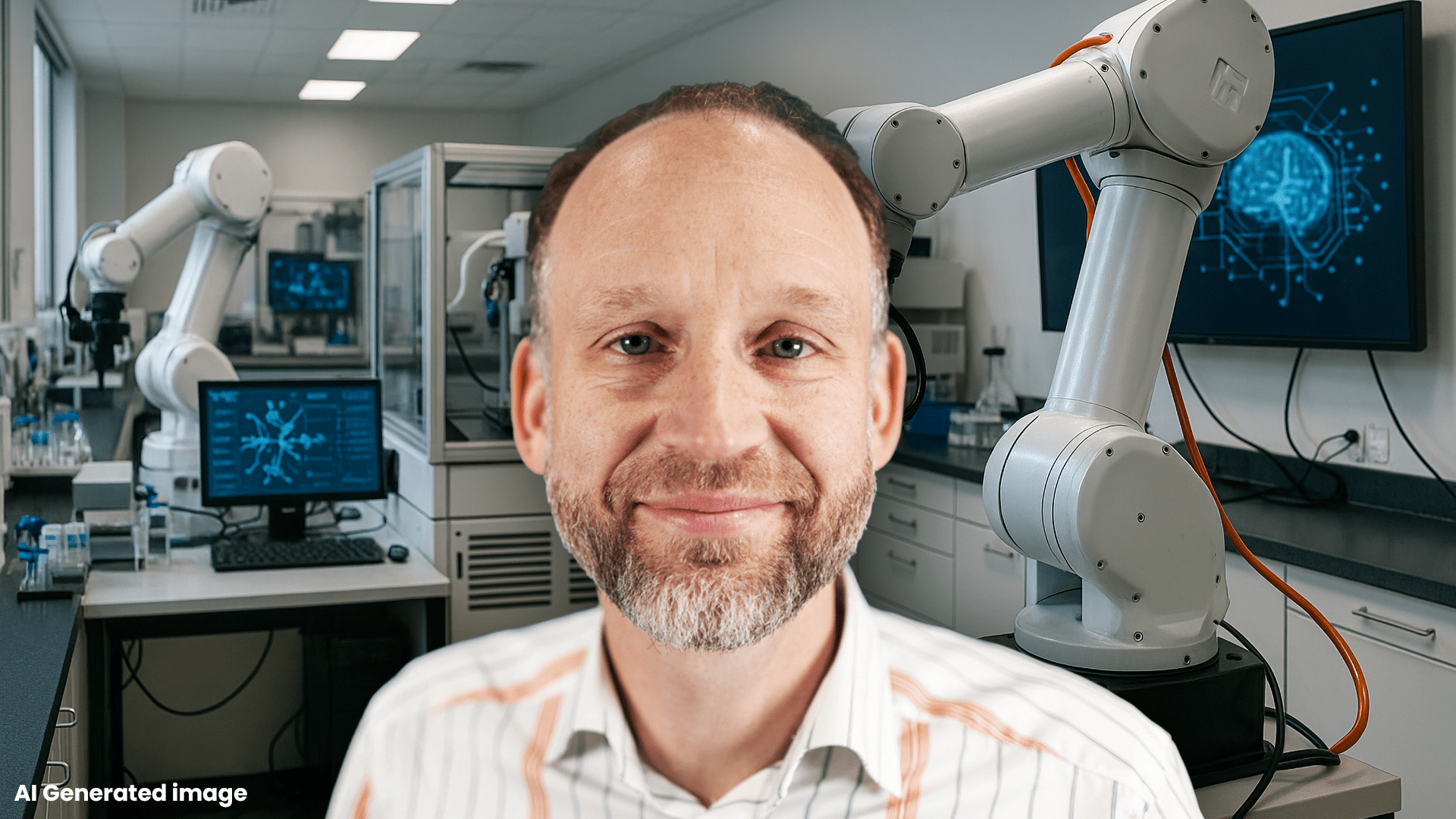

SciLifeLab Voices: Ola Spjuth
This time in our SciLifeLab Voices series, we sat down with Ola Spjuth, Professor at Uppsala University and SciLifeLab AI Lead, to talk about his pioneering work at the intersection of life science, automation, and artificial intelligence. From his robotic pharmaceutical lab to his role in shaping SciLifeLab’s national AI strategy, Ola shares insights on how AI is transforming research and what lies ahead for Sweden’s life science community.
You lead a dynamic research group at Uppsala University working at the interface between life science, data, and technology. What are the main scientific questions your lab is exploring right now?
My research focuses on how AI and automation can change the way we explore biology. We aim to understand how cells respond dynamically to drugs, toxins, or genetic perturbations. A central question is how to use AI to integrate high-content imaging, molecular profiling, and time-resolved experiments. We also explore how to make experiments adaptive — where AI can propose what to test next. In short, we are developing the foundations for autonomous discovery systems, combining high-throughput experimentation with AI and self-driving lab concepts. Of particular interest to me is to apply these systems and screen for novel drug combinations.
Your lab has gained attention for using automation and artificial intelligence in experimental research. What opportunities — and perhaps challenges — have you encountered when combining these approaches?
Automation and AI together create the possibility of iterative, data-driven science, where the AI model continuously learns and guides the next experiments – enabling us to design better experiments much faster than before. We are still early in our development and my experiences from building automated robotized labs is that it requires quite some investments in instrumentation and close collaboration between life scientists, engineers, and computer scientists to build the control systems and data pipelines. It can be challenging to have and maintain all these competences in an academic research group.
Beyond your own research, you have also been leading the work on SciLifeLab’s new AI strategy. How did that process begin, and what were your main goals when shaping it?
I was appointed AI Lead at SciLifeLab in January 2025, and during the spring we started a broad dialogue with experts across Sweden and internationally – including infrastructure leaders, researchers and partners in industry. I also formed a strategic reference group. The main goal is to outline a strategy for how to make AI an integrated part of SciLifeLab’s infrastructure in order to accelerate discovery and innovation in Sweden.
The AI hearing earlier this autumn gathered strong engagement from the life science community. What did you take away from that discussion — and how will it influence the next steps for the strategy?
I found it a very positive hearing. Many relevant comments and questions were raised, and I will now together with the AI strategy group go through these and discuss how we should update the AI strategy.
A central theme in the hearing was “AI-ready data and infrastructure.” How do you see these national efforts translating into everyday research possibilities for scientists across Sweden?
AI-ready data means FAIR, standardized, and annotated datasets that can directly feed into machine learning workflows. Achieving this is not easy, and SciLifeLab recently launched the Integrated Data Services (IDS) project to propel SciLifeLab platforms’ capabilities towards this end. The impact for researchers is that SciLifeLab datasets can be discoverable in e.g. portals, easily integrated with other data modalities across platforms and units, and analysed using standardized workflows and using high-computing resources.
AI adoption often involves balancing ambition with practical realities — from data sensitivity and security to cost and the rapid pace of commercial AI development. How do you think SciLifeLab should navigate that balance?
I think we need a responsible but pragmatic approach. We need to protect sensitive data and follow the highest standards of ethics and responsibility. My view is that we need to follow the latest developments and run local systems, services and host e.g. foundation models where openness and transparency are key priorities. At the same time, we should leverage commercial advances and attempt to bridge academia with industry that currently are driving a lot of the latest developments in AI.
Ethical and social aspects came up repeatedly during the hearing — from data bias to environmental cost. What responsibilities do you think infrastructures like SciLifeLab have in ensuring AI is used responsibly?
Ethics, Responsible AI, and Regulatory Compliance is one of the central guiding principles in the AI strategy. SciLifeLab should work to ensure that AI models are transparent, explainable, and fair, and that data are used in line with both ethical and legal frameworks. Environmental impact was also brought up at the hearing, and SciLifeLab should definitely promote efficient compute usage and awareness of sustainability in large-scale AI projects.
AI training and education were also discussed, both for researchers and students. What do you see as the most important steps to build AI competence across the life sciences community?
We need to expand on AI training on all levels – from introductory courses for experimentalists to advanced workshops for AI specialists. This should be done via the SciLifeLab Training Hub. We should also strive to build an active national AI community that can support each other and collaborate across institutions. In the longer run, recruiting skilled younger researchers is important to bring in and build up competence in Sweden.
Implementing a strategy is always different from writing one. What do you see as the biggest practical challenges in turning the AI strategy into reality over the coming years?
SciLifeLab is a large and diverse organization with many data-generating platforms and units having different setups with instruments, data, and people. I think this heterogeneity will pose many challenges. Another challenge is maintaining momentum — ensuring that pilots and projects become long-term services and that we continue adapting to technological change as the speed of AI developments is very high.
The strategy is described as a living document that will evolve over time. How do you see it developing as technologies and research needs continue to change?
AI is moving incredibly fast, and the strategy must evolve with it. We need to stay up to date with the latest trends and pilot emerging technologies so that we can filter and translate them to the life sciences. At the same time we need to stay updated on new needs from scientists, and regulatory developments. These are capacities we need to build up at SciLifeLab.
Finally, a few personal questions to get to know Ola a bit better. What are the best and worst things about the Swedish winter? And what’s your favorite vacation destination and sport?
The best thing about the Swedish winter is winter sports, and the worst is when there’s no snow. My favorite vacation destination is Italy, and my favorite sport is bandy.
Olas SciLifeLab page