
Ola Spjuth awarded Hjärnäpplet for AI-driven robotic lab
SciLifeLab researcher and AI lead, Ola Spjuth (UU), has been awarded Uppsala University’s innovation prize, Hjärnäpplet, for his work building a robotic pharmaceutical laboratory driven by artificial intelligence. The award will be conferred during the university’s anniversary celebrations on October 7.
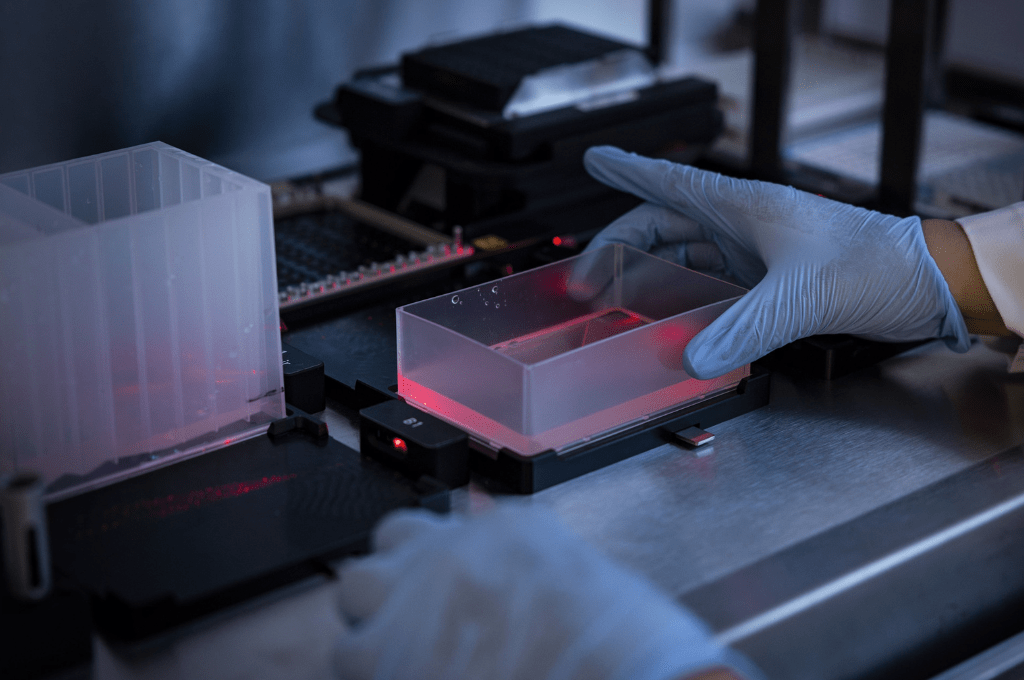
During the past years, Ola and his team have integrated automation, high-throughput experimentation, and deep learning in a unique pipeline for drug screening and safety evaluation. Starting from automated microscopy and the “Cell Painting” protocol, the system enables large-scale profiling of how different substances affect cellular organelles and viability. The data generated feed AI models to predict pharmacological effects and toxicity endpoints, but the system also enables screening for new and repurposed drugs.
“Robots are great at doing exactly the same thing over and over again. Apart from enabling experiments at scale, this ensures a high degree of repeatability and data quality, which is of uttermost importance when using AI as a fundamental component in research” says Ola.
Collaboration with CBGE
A key factor behind the success is the close collaboration with national research infrastructures: Spjuth’s group is embedded as a node of the Chemical Biology Consortium Sweden (CBCS), a SciLifeLab infrastructure unit that supports Swedish researchers in assay development, small molecule screening, and computational chemistry. Together with the CRISPR Functional Genomics and Chemical Proteomics units, CBCS forms the SciLifeLab Chemical Biology Genome Engineering service area (CBGE), designed to bridge large-scale phenotypic screening with mechanistic insight.
The environment created by Ola’s team contributes to high-content phenotypic profiling and AI/data-analysis support for the CBCS unit as well as expertise in automation and machine learning. At the same time, the infrastructure enables Ola’s lab to scale up and service external projects.
Hjärnäpplet
By integrating infrastructure, collaboration, and translational ambition, Spjuth’s work embodies one of SciLifeLab’s main missions: to turn advanced platform technologies into broadly enabling tools for life science research. Based on the experiences, Spjuth has together with collaborator Jordi Carreras-Puigvert established a spin-off company, Pixl Bio (formely Phenaros Pharmaceuticals), that has built up a robotized lab with the focus on predictive biology and drug safety. The award highlights not only a compelling lab and innovation, but also the infrastructure ecosystem that makes such innovation possible.
Links:
CBCS: https://www.scilifelab.se/units/cbcs/
Spjuth research group: www.pharmb.io
Pixl Bio: www.pixl.bio
News article from Uppsala University: Ola Spjuth wins Hjärnäpplet for robotic pharmaceutical lab – Uppsala University