
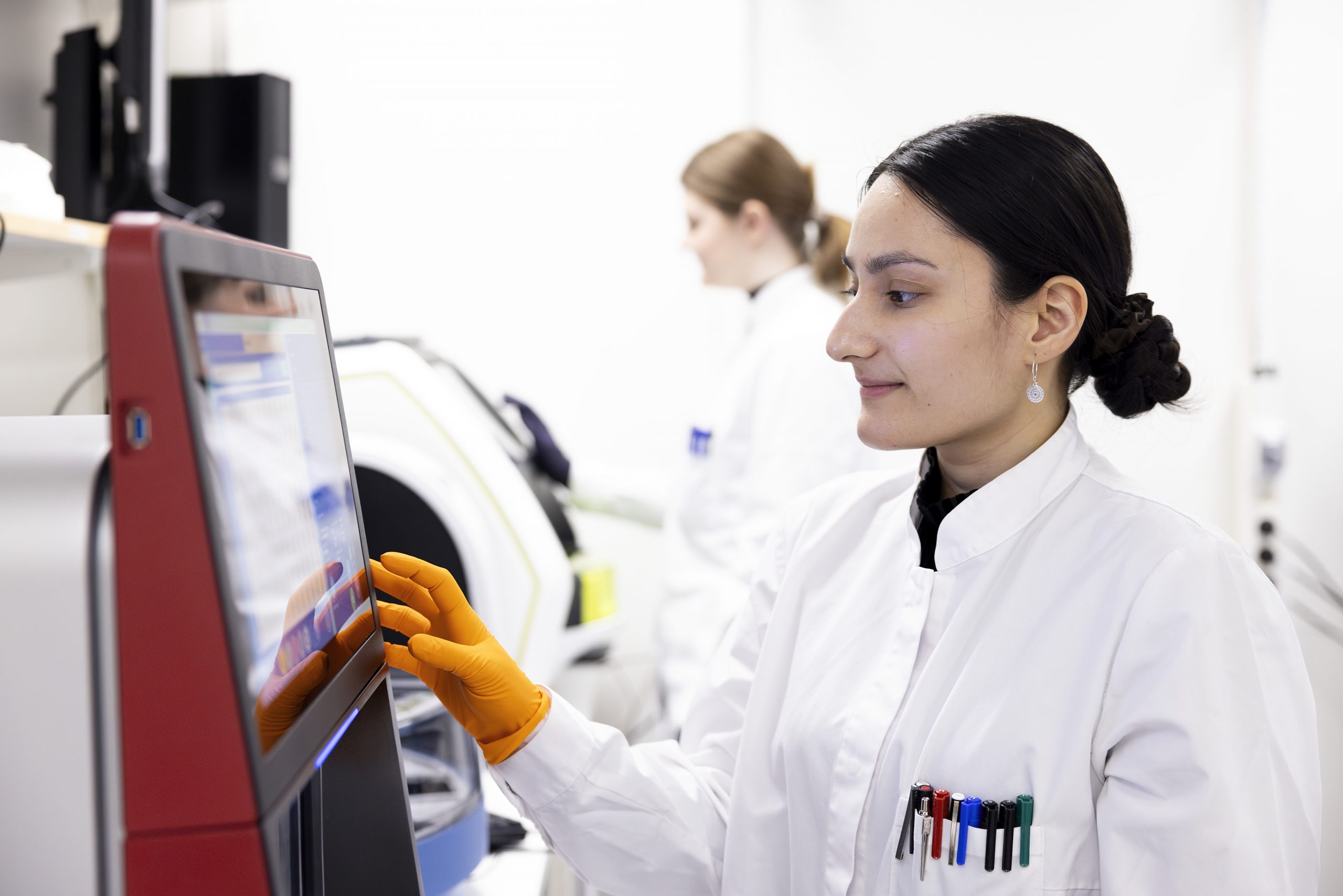
The Affinity Proteomics units supports protein analysis across various biological and clinical context, including high-throughput protein profiling and quantitative biomarker analysis.
Use our ImmunoAssayFinder App to check which technologies available at the unit cover your target of interest.
- Centers on biomarker discovery, validation, and quantitative protein analysis.
- Utilizes technologies like Proximity Extension Assays (PEA) and in situ PLA for sensitive and multiplexed protein detection.
- Designed for large-scale studies involving protein-protein interactions, post-translational modifications, or quantification in body fluids, cells, and tissues.
- Strongly supports clinical and translational research, including precision medicine applications.
Affinity Proteomics
- Focuses on analyzing the immune response, particularly autoantibodies and other immune markers.
- Provides expertise in serology-based profiling to study autoimmunity across a wide range of conditions.
- Ideal for researchers studying autoimmune diseases, vaccine responses, or general immunology.
- Offers services such as customized autoantigen microarrays for identifying disease-specific autoantibody patterns, and high-throughput serology to assess immune responses.
Not sure what best suits you need? Get in touch!
Unit information
Affinity Proteomics
Skip to
Introduction
News
Services
Applications
Project prioritization and cost model
Equipment
Addresses
Introduction
The Unit of Affinity Proteomics offers a long-standing expertise in the analysis of human body fluids, cells, and tissue lysates. We also provide analysis of protein-protein interactions and activation in situ or in tissues. Our services aim to support researchers and clinicians in the fields of translational and personalized medicine providing access to an exquisite infrastructure to apply cutting edge immunoassays technologies for multiplexed protein quantification.
We support biomarker studies from discovery to validation, in a large number of samples and a variety of human conditions. Our services include all aspects such as study design, selection of antibodies, data processing and we also develop alternative assays tailored for the specific needs of the user’s projects.
The unit also provides infrastructure and technologies for analysis of the autoantibody repertoire in body fluids and antibody validation using custom designed protein and peptide arrays.
Supported by the resource of more than 42 000 unique human protein fragments generated within the Human Protein Atlas, representing more than 18 000 human protein coding genes, we offer proteome wide screening for autoantibody reactivity on large microarrays, as well as downstream solutions for investigation of autoantibody repertoires in hundreds of patient samples in parallel. Instrumentation and know-how is available for generating customized spotted protein microarrays as well as measurement and analysis of commercially available protein microarrays.
Do you want to learn more about our technologies? Do you have an exciting project idea? Get in touch!
News
The Affinity Proteomics-Stockholm is now part of the Biomarker platform within the European infrastructure for translational medicine (EATRIS). EATRIS is a non-profit European Research Infrastructure Consortium (ERIC) which aims to facilitates collaboration among researchers, physicians, and developers and supports the establishment of multidisciplinary projects in the field of personalized medicine.
- On July 1st 2025 the Affinity Proteomics Stockholm node merged with the Autoimmunity and Serology Profiling unit to form a more comprehensive Affinity Proteomics Stockholm node.
- Olink Explore HT, for the analysis of 5400+ proteins in only 2 µl sample, is now available at the Uppsala node
- In 2023 the Stockholm’s lab as been reconstructed and now is qualified as BSL 2
- A new system for high-throughput processing of volumetric dried blood spots is now available (PA496,Capitainer®)
- Acquisition of the Quanterix SPX Imaging and Analysis System Instrument for ultrasensitive chemokine/cytokines quantification
Services
- Proximity Extension Assays (Certified service provider for Olink Proteins AB)
Target 96, Target 48, Flex, Focus (Stockholm and Uppsala)
Olink Reveal (Stockholm and Uppsala)
Olink HT 5400+ (Uppsala) - Illumina SomaSeq (9500 protein panel) (Uppsala)
- NULISA Alamar (Stockholm)
- Multiplexed sandwich immunoassay (Commercial kits for Luminex System up to 40 targets) (Stockholm)
- Automated microfluidic immunoassays (ProteinSimple) (Stockholm)
- Ultrasensitive immunoassays (Quanterix®) (Stockholm)
- MesoScale’s ECL products (Meso Scale Discovery) (Uppsala)
- SPEAR UltraDetect™ wash-free, ultra-sensitive, ultra-low volume immunoassays (Uppsala)
- Development of novel quantitative immunoassays (Homebrew Luminex and Quanterix® systems ) (Stockholm)
- Customized proximity extension (PEA) and proximity ligation assays (PLA) with dual and triple antibody recognition (Uppsala)
- Analysis of the cell surface protein interactome by Proximity Network Assay (Pixelgen) (Uppsala)
- Commercial in situ PLA assays (Navinci Diagnostics) (Uppsala)
- Development of customized PLA assays to detect proteins interactions and/or post-translational modifications
in tissue (imaging), cells in suspension and extracellular vesicles(flow-cytometry) (Uppsala) - Application of PLA sensitivity and specificity of Western blot (Uppsala)
- Autoantibody/self-antigen discovery
- Epitope mapping
- Antibody validation
- Infrastructure for commercial protein arrays
- Protein-protein interactions
- Protein-small molecule interactions
- Protein-nucleic acid interactions
- Selection of antibodies targets (access to 50000 antibodies from the Human Protein Atlas (HPA)) (Stockholm)
- Antibody validation (Stockholm)
- Multiplexed assessment of optimal antibody pairs (Luminex System) (Stockholm)
- Study design (Stockholm and Uppsala)
- Processing and analysis of affinity proteomics data (Stockholm and Uppsala)
- Statistical and bioinformatics analysis pipeline (Stockholm and Uppsala)
Applications
- High-throughput, exploratory protein profiling of human body fluids
- Biomarkers discovery and validation in large sample cohorts
- Robust protein quantification for candidate biomarkers
- analysis of proteins interactions and/or post-translational modifications in cells and tissues
- Development of novel immunoassays concepts
- Antibody validation and selectivity analysis
- Untargeted profiling the autoantibody repertoire in plasma, serum or CSF by screening on high-density protein microarrays
- Verification of autoantibody profiles on suspension bead arrays with selected antigens.
- Epitope mapping and off-target analysis of affinity reagents as well as identified autoantibodies on antigen or peptide microarrays.
- Infrastructure and know-how to analyze commercial protein arrays such as CDI Labs HuProt Human Proteome Microarray, Somalogic KREX-technology i-Ome Discovery arrays, and peptide arrays from PEPperPRINT and JPT.
- High-throughput SARS-CoV-2 serology screening for antibodies towards SARS-CoV-2 viral proteins in human serum/plasma
Project prioritization and cost model
The unit provides service for clinical and translational research on a first-come first-served basis. Projects with principal investigators from Swedish Universities are prioritized over projects from non-Swedish universities and industry. Collaborative development projects are prioritized based on the expected importance of the development work for future research service projects or healthcare applications. Project requests are typically directed to a specific node depending on the research question and what assay to use.
Academic users benefit from a subsidized cost including assay dependent reagents, and a user fee, including instrument related cost and consumables. An hourly fee can be added for experimental work exceeding the normal cost for the assay. For industry we apply a full-cost model, always including hourly fee. Collaborative projects can be further subsidized or covered by joint grants.
Equipment
- 50 000 antibodies from the Human Protein Atlas project
- 42 000 antigens from the Human Protein Atlas project
- 3x FLEXMAP 3D, Luminex®
- xMAP INTELLIFLEX, Luminex®
- Arrayjet Super Marathon with JetMosphere Max™ controlled environment.
- Innopsys InnoScan 1100 AL 3-channel ultra-high resolution microarray scanner
- LX200, Luminex®
- MAGPIX, Luminex®
- ELLA, ProteinSimple®,
- ARGO™ HT System, Alamar Biosciences®,
- SIMOA SR-X, Quanterix®
- SIMOA SP-X Imaging and Analysis System, Quanterix®
- MESO QuickPlex SQ 120MM imager, Mesoscale®
- MESO SECTOR S 600MM imager, Mesoscale®
- CytoFLEX S Violet-Blue-Yellow Green-Red (V-B-Y-R)
- Olink Explore (F.A.S.T and Dragonfly dispensers, EpMotion liquid handler, NovaSeq X, ProFlex PCRs)
- Olink Signature Q100
- QuantStudio6 Flex Real-Time PCR Systems with 96 and 384 interchangeable blocks. Applied Biosystems
- C1 Single-Cell Auto Prep system, Fluidigm®
- Epifluorescence microscopes: fully automated stages on Zeiss Axio Imager Z2 and Leica DMi8
- Molecular Devices MetaExpress automated scanning microscope.
- SomaSeq Automation System (a custom Tecan Fluent 780)
- FLUENT, Tecan
- 2x EVO150, Tecan
- SELMA, CyBio®
- PA496 Pre-analytical Automation for qDBS analysis, Capitainer®
- 2x Biotek EL406 plate washers
- KingFisher Flex, Thermo
- EL406 Washer Dispenser, Biotek
- 405 LS and TS, Biotek
- Simoa Microplate Washer system, Quanterix®
Adresses
Mailing address
Affinity Proteomics Stockholm
Box 1031 Scilifelab
171 21 Solna
Sweden
Deliveries & visiting address
Tomtebodavägen 23A/B
SciLifeLab, 171 65 Solna
Sweden
Contact person for deliveries: Maryam Sahi, maryam.sahi@scilifelab.se
Mailing address
Affinity Proteomics Uppsala
Box 392
Biomedical Center, BMC
751 06 Uppsala
Sweden
Deliveries & visiting address
Husargatan 3, Entrance C11
Biomedical Center, BMC 752 37 Uppsala
Sweden
Contact person for deliveries: Cecilia Kriegholm, cecilia.kriegholm@medsci.uu.se