
Science Communication: SciLifeLab PULSE Future Leaders’ Perspective
Future Leaders’ Perspectives share the thoughts of the SciLifeLab PULSE Postdoc cohort on leadership, science communication, and key competencies. Each instalment is part of the transferrable skills training program, where postdocs reflect on expert interviews and practical assignments within these topics.
On the challenges and benefits of science communication
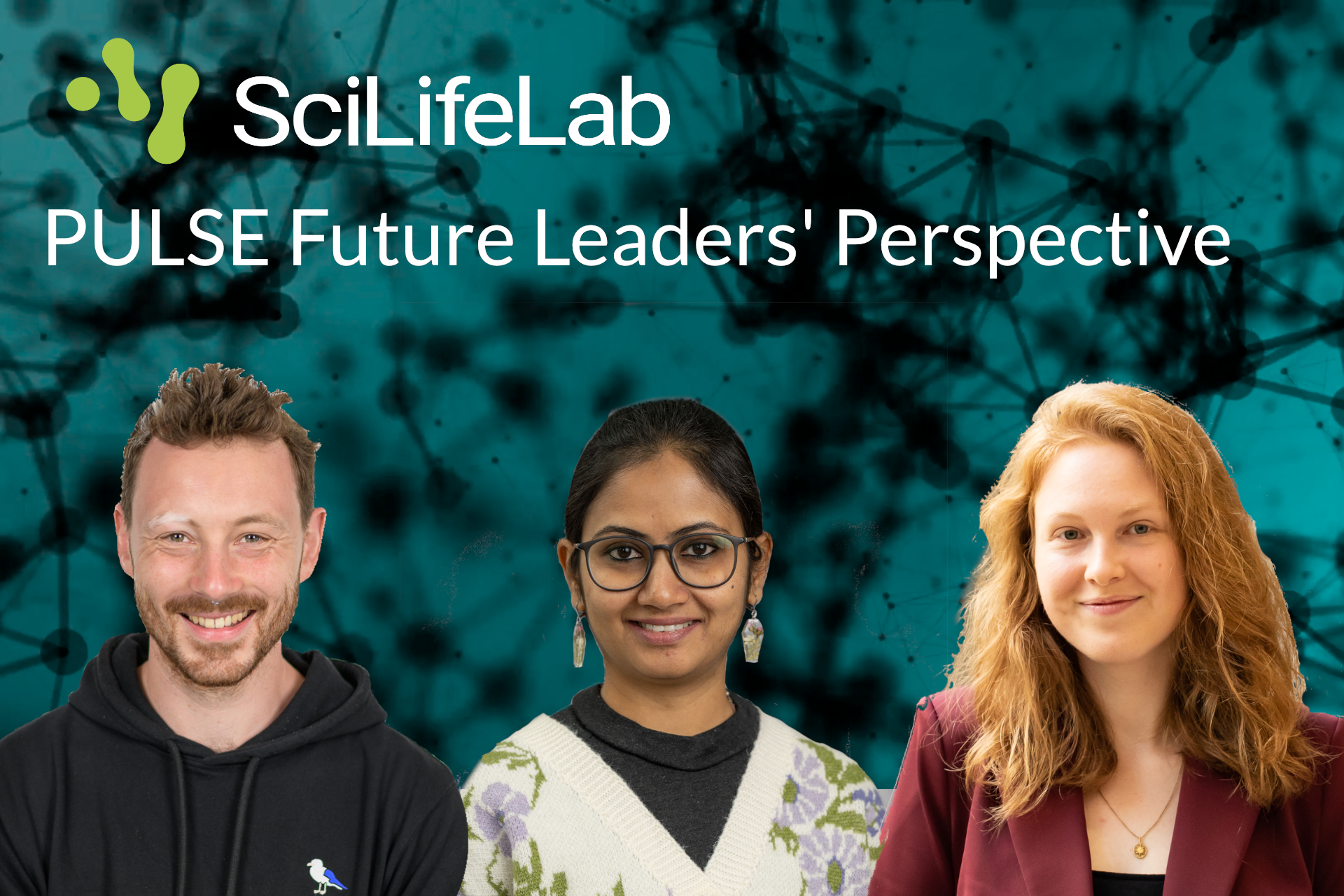
by Guillaume Lavanchy, Chaitra Shankar, and Barbara Walenkiewicz
Editor: Victor Weman
Over the past century, science has advanced tremendously through extensive research not only in medical sciences but also in other fields such as ecology, veterinary medicine, and sociology. However, the findings of these studies are often published in specialized scientific journals that are primarily accessed by researchers and therefore fail to reach the broader public. Science communication serves as a vital medium through which complex scientific research can be simplified and shared with society, effectively bridging the gap between scientists and the public. Despite its importance, science communication has long been undervalued. In recent decades, however, there has been a significant increase in science communication efforts due to the widespread use of social media and the emergence of new platforms that enable outreach to diverse and large audiences.1
Much of scientific research is funded by taxpayers’ money allocated by state and central governments, making evidence-based science communication essential for educating the public about the outcomes and societal relevance of this research. By translating scientific findings into accessible language, science communication helps the public appreciate the value of their tax contributions and understand how ongoing research impacts everyday life. For example, summarizing studies on the benefits of influenza vaccination can inform communities about the importance of vaccination while also highlighting the need for continued investment in pharmaceutical research.2 Such population-based studies can further assist policymakers in updating or refining vaccination schedules to improve public health outcomes.3Additionally, by engaging in outreach activities and interacting with young audiences, scientists can inspire curiosity, creativity, and a lasting interest in science. Public engagement through science communication not only fosters interdisciplinary collaboration—such as between ecology and sociology—but also encourages researchers to reflect on the translational and societal implications of their work, potentially guiding future research directions.
Science communication today is shaped by a series of persistent and increasingly interconnected challenges that demand attention from funders, universities, principal investigators (PIs), and trainees at all stages. A central tension lies in the tradeoff between accessibility and accuracy: distilling complex findings into relatable narratives risks oversimplification, yet excessive technical detail can alienate non-specialist audiences and even fellow scientists outside a given subfield.4,5 This challenge is amplified by the growing use of artificial intelligence (AI) and large language models (LLM) as tools for engaging with scientific knowledge. While AI offers clear advantages, such as rapid summarization, translation across disciplinary boundaries, and assistance in rephrasing dense material, it also introduces pitfalls such as data hallucination, loss of nuance, and a false sense of certainty.6–8 Overreliance on these tools may inadvertently erode scientists’ own capacity to articulate uncertainty, disagreement, and methodological limitations, all of which are fundamental to scientific integrity. Compounding these issues are the realities of communicating science in a societal context shaped by strong a priori beliefs, political polarization, and controversy surrounding the implications of research, particularly in areas such as climate, health, or emerging technologies.9 In these settings, evidence is often filtered through values and identities, making it difficult to communicate findings without triggering defensiveness or mistrust.5Scientists also struggle with how to convey uncertainty responsibly – how to be transparent about limitations, probabilistic outcomes, or evolving evidence without undermining credibility or fueling misinterpretation. This is especially challenging when disagreement exists within the scientific community itself, as public-facing narratives often demand clear answers where none yet exist. Pressures within academia further exacerbate these problems: incentives to demonstrate impact, secure funding, and attract attention can encourage overstating the importance or implications of results, blurring the line between effective communication and hype.10 Finally, unequal access to reliable, understandable scientific information remains a structural barrier. The public, and even researchers outside elite institutions, must navigate paywalls, technical jargon, and an overwhelming volume of content of variable quality, often without clear guidance on how to assess credibility.11,12 Taken together, these challenges highlight that effective science communication is not merely an individual skill but a systemic responsibility.9,13–15 Funders and institutions must recognize and support communication as core scholarly labor; PIs must model responsible, transparent practices; and trainees must be equipped not only with tools, including AI, but also with critical judgment about their use.8 Without coordinated attention across these levels, the gap between scientific knowledge and public understanding risks widening at precisely the moment when trust in science matters most.
These different challenges can be overcome, but require several strategies. In our opinion, the first and foremost task of every communicator is to identify their audience. Each communication activity is different, and this exercise must be repeated every time. Concretely, this means seeking to understand which people make up the audience, what they already know, how much information they can take. This is necessary to calibrate the amount of background that needs to be conveyed along with the novel piece of information, as well as how much effort is needed to help the audience make sense out of it. For most audiences, focusing on a few, well-designed punchlines will often be more effective than attempting to provide too much information. Strategies to help the audience understand complex scientific information include the use of examples, as well as metaphors that translate abstract concepts into common knowledge or experienced sensations. Picking examples carefully enables to make them more relatable (i.e. reducing “psychological distance”)16. The best examples come from places that the audience is familiar with; they have occurred recently; they concern people that the audience identifies with; and they are likely, as opposed to hypothetical. Similarly, metaphors must refer to something that the audience is familiar with and ideally has experienced, or they risk backfiring. For this reason, identifying the audience does not stop at their education level and knowledge of the subject, but also encompasses their cultural references. Importantly, one must also strive to assess whether they have values, beliefs, or misconceptions that may conflict with the message. Endorsing a message to which the audience is hostile risks damaging one’s image of trustworthiness (what Aristotle called “ethos”)17. Establishing a common ground of shared values is thus needed before drifting into controversy. An important task when designing a communication activity is giving context, or “setting the stage”. In other words, telling the audience why it matters before telling them what it is about. Finally, communication is also a matter of emotions (Aristotle’s “pathos”), and showing enthusiasm for our research is probably the best way to ensure a mirroring effect in the audience.
Ideally, scientific communication’s reach would be universal, targeting everybody across geographic, demographic and socio-economic categories. However, there is no such thing as a universal means to reach all layers of society. A variety of formats should thus be explored. This includes sending press releases to specialized and generalist newspapers as well as radio and television stations, contacting journalists directly, giving talks for the general public or for specific audiences, taking part in organised events such as exhibitions, exploiting social media by creating videos, podcasts or vlogs, and blending science with art.
Scientists should explore formats that they find most useful and fun for their message. While not every scientist needs to become a professional science communicator, a diversity of communicators can reach a broader audience than a few specialized ones. Explaining science to a non-expert audience also helps by providing us with tools and metaphors that can be helpful for teaching, grant writing, and giving talks to academic colleagues. By focusing the effort on explaining why science matters, it may help us remember why we do it in the first place. Thus, effective science communication not only benefits the audience, but also the policy makers/government and scientists themselves to drive their work and herald their findings.
References
1. Science communication in the digital age: Trends, gaps, and interdisciplinary opportunities – Peeyush Phogat, Shanay Rab, Meher Wan, 2025. https://journals.sagepub.com/doi/10.1177/18758789251342896.
2. Steier, J. B. Using Social Media to Combat Influenza Vaccine Misinformation and Improve Uptake: A Social Media Campaign and Repeated Cross-sectional Survey Analysis. Mayo Clin Proc Digit Health 3, 100229 (2025).
3. Engaging Scientists in Policy Discourse – PubMed. https://pubmed.ncbi.nlm.nih.gov/35765515/.
4. National Academy of Sciences. The Science of Science Communication III: Inspiring Novel Collaborations and Building Capacity: Proceedings of a Colloquium. (National Academies Press (US), Washington (DC), 2018).
5. Lupia, A. Communicating science in politicized environments. Proceedings of the National Academy of Sciences 110, 14048–14054 (2013).
6. Biyela, S. et al. Generative AI and science communication in the physical sciences. Nat Rev Phys 6, 162–165 (2024).
7. Alvarez, A. et al. Science communication with generative AI. Nat Hum Behav 8, 625–627 (2024).
8. Banerjee, S., Agarwal, A. & Singla, S. LLMs Will Always Hallucinate, and We Need to Live With This. Preprint at https://doi.org/10.48550/arXiv.2409.05746 (2024).
9. National Academies of Sciences, Engineering, and Medicine, Division of Behavioral and Social Sciences and Education, & Committee on the Science of Science Communication: A Research Agenda. Communicating Science Effectively: A Research Agenda. (National Academies Press (US), Washington (DC), 2017).
10. Milano, G. Raccontare la scienza.Rischi, opportunità e nuovi strumenti del comunicare. Recenti Progressi in Medicina 110, 11–17 (2019).
11. Scheufele, D. A. Communicating science in social settings. Proceedings of the National Academy of Sciences 110, 14040–14047 (2013).
12. Peters, H. P. Gap between science and media revisited: Scientists as public communicators. Proceedings of the National Academy of Sciences 110, 14102–14109 (2013).
13. Fischhoff, B. The sciences of science communication. Proceedings of the National Academy of Sciences 110, 14033–14039 (2013).
14. Nisbet, M. C. & Scheufele, D. A. What’s next for science communication? Promising directions and lingering distractions. American Journal of Botany 96, 1767–1778 (2009).
15. Fischhoff, B. Evaluating science communication. Proceedings of the National Academy of Sciences 116, 7670–7675 (2019).
16. Trope, Y. & Liberman, N. Construal-level theory of psychological distance. Psychological Review 117, 440–463 (2010).
17. Aristote. Rhétorique de Aristote – Editions Flammarion. https://editions.flammarion.com/rhetorique/9782080711359.
This perspective was developed as part of the SciLifeLab PULSE Transferable Skills Training programme, 2026. Co-funded by the European Union. Views and opinions expressed are those of the author(s) only and do not necessarily reflect those of the European Union or the European Research Executive Agency.