
Lauri Robbins-Ericson: “The barriers women face are not about ability — they never were”
Academia in Sweden is still hierarchical, still male-dominated at senior levels, and still shaped by structures that were designed long before women were expected to lead them, but this can be changed if organizations take this seriously, says equality expert Lauri Robbins-Ericson in our in-depth Q&A.
For this year’s International Women’s Day, we asked equality expert Lauri Robbins-Ericson to share her insights on what some pressing issues for women in STEM are right now, what organizations can do to address these issues, and what actually works when aiming for structural change.
“Let me be direct: the problem is not the women.”
Lauri Robbins-Ericson is the Founder & CEO of Lauri.co, a social impact consultancy working at the intersection of equity, social innovation and leadership. She has designed and led women’s leadership programs across the US, Asia, and Europe, and is the creator of the GENIE women’s leadership program at Chalmers University of Technology. More about Lauri Robbins-Ericson can be found below the Q&A.
What are the most pressing issues for women in STEM, in your view?
Let me be direct: the problem is not the women. The women I work with are extraordinary. Accomplished, rigorous, intellectually courageous. And fun. They have earned everything they have, often while carrying invisible weight that their male colleagues do not. The problem is the environment — and Sweden is not exempt from this, despite its reputation. Academia here is still hierarchical, still male-dominated at senior levels, still shaped by structures that were designed long before women were expected to lead them.
And the damage starts early. By age six, research shows, in many countries around the globe, girls and boys may already associate brilliance with boys — and girls begin opting out of activities deemed to require it. So when women arrive in STEM, the message about who science is for has been widely reinforced. They are talented and credentialed and driven. They are also navigating a system that was not built with them in mind, full of unspoken rules they were never taught.
“The question is whether institutions are willing to see it — and do something harder than a workshop about it.”
This is not solely a pipeline problem. It is a belonging crisis. And it is compounded every time a teenage girl won’t raise her hand in high school for fear of getting the answer wrong, or a woman is interrupted in a meeting, or sees her idea credited to a colleague, or is asked to do the emotional and administrative labor that keeps a department running while her peers build their publication records.
That is what we are actually dealing with. The question is whether institutions are willing to see it — and do something harder than a workshop about it.
What can organizations do to address these issues?
Start with honesty. Not your diversity statement — your data. Who sits on your hiring panels? Your leadership team and board? Who gets authorship credit? Who is sponsored for leadership roles versus who is mentored, congratulated, and sent back to their desk? The gap between those two things — sponsorship and mentorship — is one of the most consequential and least discussed inequities in academic institutions.
Then look at your informal culture. Who gets interrupted? Whose ideas travel under someone else’s name? Who absorbs the invisible labor? These patterns are almost always invisible to the people who benefit from them. Making them visible is not comfortable. It is necessary.
“The organizations making real progress share one quality: a leader at the top who treats gender equity as a condition for institutional excellence.”
Concretely: review your evaluation and promotion criteria with a genuine gender lens — not a symbolic one. Require diverse hiring panels as policy, not gesture. Move from mentoring women to sponsoring them for high-visibility opportunities. Publish your data. Hold leaders accountable for outcomes, not intentions.
And create real space — sustained, resourced, taken seriously — for women to connect and develop together. Not a network. A community. The difference matters: community is where women stop managing their loneliness and start building their power. Women in research departments can go weeks without a single conversation with another woman about what it actually feels like to work there. That silence has a cost — to the women, and to the institution.
The organizations making real progress share one quality: a leader at the top who treats gender equity as a condition for institutional excellence — not an HR initiative, not a reputation management exercise. A genuine strategic imperative, resourced and measured accordingly.
What actually works when aiming for structural change?
Targets work, developing a Theory of Change works. Not quotas framed as lowering the bar — explicit, public goals held to the same standard as financial performance. When gender equity is measured, it gets taken seriously. When it isn’t, it gets talked about at IWD events and forgotten by March 9th.
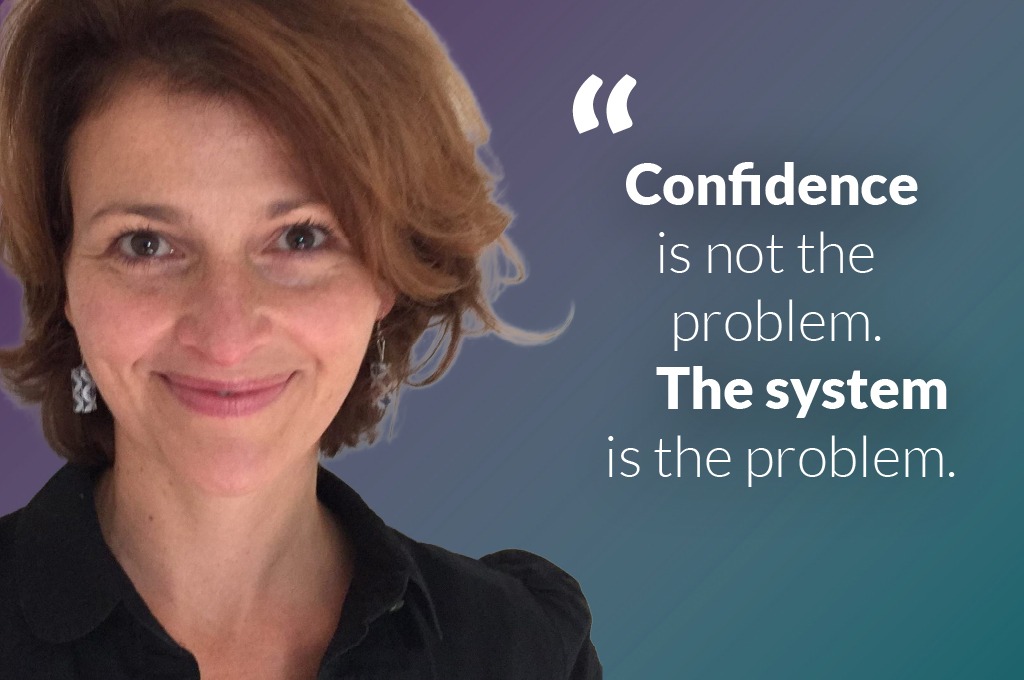
“Confidence is not the problem. The system is the problem.”
Transparency works. Publishing pay gaps, promotion rates, and representation data creates accountability that good intentions alone cannot.
Fixing the process works far better than fixing the people. When you redesign the evaluation system rather than coaching women to survive a broken one, outcomes shift. This sounds obvious. It remains radical in practice.
What does not work: one-off trainings, voluntary initiatives, programs with no leadership buy-in, and the deeply persistent belief that if we just build women’s confidence, the system will open up for them. It won’t. Confidence is not the problem. The system is the problem.
What works — and what the evidence from these programs shows consistently — is working the individual and the system simultaneously. Women are given the tools to know themselves, trust themselves, and lead as themselves. And the conditions they return to begin to shift — because they shift them.
At the core of that work is leadership. Values. Understanding what drives you — because in male-dominated environments, the pressure to absorb the dominant culture’s values is constant and often invisible. Women who aren’t anchored in their own values compromise them without even realizing it.
“Understanding your own motivations is especially important for women, who often adapt to the values of those around them without noticing.“
— Researcher, Chalmers University of Technology
There is also what participants [of Lauri.co’s Women’s Leadership program] call the tribe — and it is worth being precise about this, because words matter: this is not a network. A network is transactional. You show up, you collect contacts, you leave. What forms in these programs is a community. A community shows up for each other. It holds each other accountable. It celebrates and challenges and carries each other through the hard moments. Women who arrive feeling isolated in their departments — sometimes the only woman on their floor, in their lab, at their level — suddenly find themselves surrounded by people who understand exactly what they’re navigating. That community doesn’t end when the program does.
That is the heart of this women’s leadership work — and it is the work that matters most right now. Not because women need to be fixed, developed, or made more palatable to existing systems. But because when women lead as themselves — anchored in their own values, held by genuine community, no longer waiting for permission — everything changes. The science gets better. The institutions get braver. The next generation of women arriving in STEM finds a different world waiting for them.
I build the conditions. The women do the rest. And what they do with it — that is the work that actually changes the system.
Where will we be in five years if organizations implement this? What could be achieved?
If organizations move from performative to structural — and the ones that do will be rewarded for it, in talent, in retention, in the quality of their science — we will see women not just entering STEM but leading it. Shaping research agendas. Sitting at the tables where decisions are made. Redefining what excellence looks like, because diverse leadership asks different questions and catches what homogeneous thinking misses.
We will see more women in leadership — real leadership, not advisory roles and committees, but the rooms where research priorities are set, where funding is allocated, where the future of science is decided. And alongside more women, we will see more diverse leaders across every dimension: race, background, experience, perspective. Because gender equity done right does not just open the door for one group. It redesigns the room.
We will see institutions that are more innovative, more rigorous, and more humane — not despite having more women and diverse leaders, but because of it. Homogeneous leadership teams ask predictable questions. Diverse ones catch what everyone else misses. The science is unambiguous on this.
“Five years is enough time to change a culture, if the will is there.”
We will see a generation of younger women and underrepresented scientists arrive in STEM already knowing they belong. Not waiting for permission. Not contorting themselves to fit a mold that was never made for them. Not quietly absorbing the message that brilliance lives somewhere else.
Five years is enough time to change a culture, if the will is there. It is not enough time to undo decades of structural exclusion — let’s be honest about that. But if the institutions that are serious right now hold the line, measure what matters, and refuse to let this become another initiative that fades after the keynote — we will have built something that cannot be undone.
And while we wait for the system to change — the women will change it. Collectively. From the inside. They will transform the norms, shift the culture, and open doors that were never opened for them. My role is to build the conditions. What happens next belongs to them. And they will not wait.
That is what this work is about. Not a program. Not an awareness campaign. Women, together, become the force that makes the old system obsolete.
Lauri Robbins-Ericson is the Founder & CEO of Lauri.co, a social impact consultancy working at the intersection of equity, social innovation and leadership. She has designed and led women’s leadership programs across the US, Asia, and Europe, and is the creator of the GENIE women’s leadership program at Chalmers University of Technology. Her TEDx talk, Shifting Gender Paradigms, is available on TED.com.
More about Lauri Robbins-Ericson
Who are you? What is your background in working with questions of equality?
I have never been able to look away. Not in Togo, where I served as a Peace Corps volunteer watching women build businesses with almost nothing — and do it anyway. Not at UN Women, not in the corridors of global development, not in the research departments of Swedish universities where brilliant women still wonder, quietly, whether they belong.
That inability to look away has shaped everything. A master’s in International Development Education at New York University — studying economics with William Easterly, learning what evidence actually demands of us. International public health at the University of Cape Town. Leadership training with some of the sharpest thinkers in the field: Richard Boyatzis at Case Western Reserve on resonant leadership; Harvard’s Margaret Wheatley on transformation and organizational resilience; Heidi Brooks at the Yale School of Management on adaptive leadership in community; organizational development at USC Marshall. A fellowship in public speaking with Heroic Public Speaking. An intensive with the altMBA — because ideas without the ability to move people are just ideas.
I co-led global strategy at Innovations for Poverty Action, co-founded by Nobel Laureate Esther Duflo and Dean Karlan, scaling evidence-based programs to 280 million children. I led partnerships at Acumen Nordics.
In 2018, I founded Lauri.co — a consultancy at the intersection of equity, social innovation and leadership. I delivered a TEDx talk, now on TED, titled “Shifting Gender Paradigms: Speak Up, Stand Up, Rise Up. I was quoted in Nature on how sexual harassment thrives in silence, even in gender-equality hotspots. And for the past several years, I have designed and led inclusive leadership and women’s leadership programs across the US, Asia, and Europe — including at Chalmers University of Technology through the GENIE initiative and at Halmstad University, serving over 100 women in STEM in Sweden alone.
That last work — the leadership work — is where everything converges. Not theorizing about change — watching it happen, in real time, in real women’s lives.