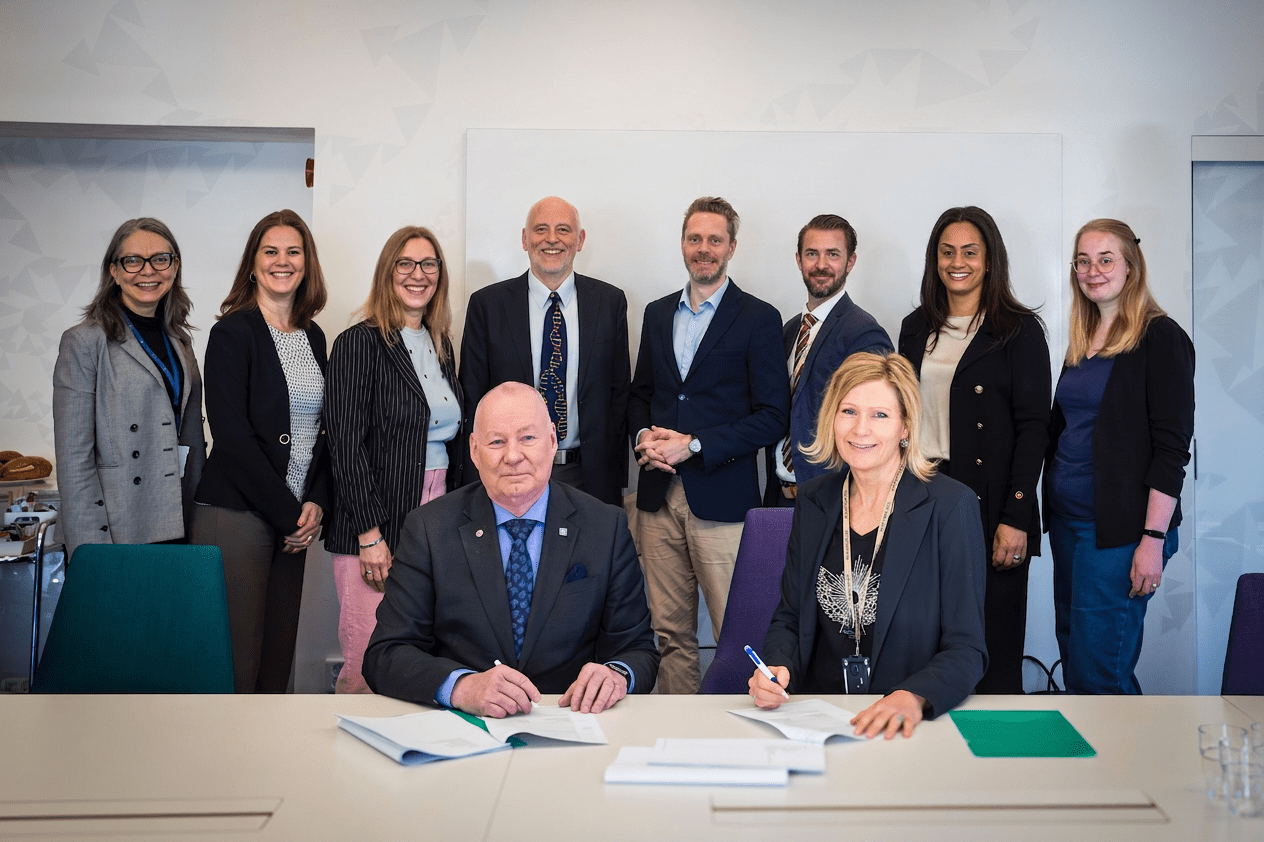
SciLifeLab is building for tomorrow’s research
This text has been translated and was originally published in on kth.se on May 4, 2026.
The SciLifeLab research center is expanding. Through a new lease agreement that KTH has signed with Akademiska Hus, the floor space at Campus Solna will increase by 50 percent. The goal is to create a world-leading research environment.
“The completion of this agreement is a milestone for the development of SciLifeLab, and we now look forward to bringing the entire project to fruition,” says Anders Söderholm, President of KTH.
SciLifeLab is a national center for molecular life sciences, founded in 2010 by KTH, KI, Stockholm University, and Uppsala University. Since then, the organization has grown significantly, with a strong focus on advanced, data-intensive research aimed at solving some of biology’s most fundamental and complex questions. This rapid growth has simultaneously made the need for more and more suitable facilities increasingly urgent.
The expansion includes the existing Beta building, which, following renovation, will be connected to the rest of Campus Solna via a shared entrance and ground floor. The goal is to create a more cohesive, modern, and functional campus. Construction is scheduled to begin in 2026, and the project is expected to be completed by the end of 2027.
Scientific breakthroughs
“By now enabling an expansion of SciLifeLab in Stockholm, we are enhancing the conditions for scientific breakthroughs in areas such as the diagnosis and treatment of serious diseases, not least with the help of new technologies in AI and so-called data-driven life science,” says Anders Söderholm.
Per Ljungdahl, Director of SciLifeLab Campus Solna, also emphasizes that the expansion is important from a national perspective and for Swedish life science:
– It significantly improves access to advanced technology and expertise, enabling research that would otherwise not be possible. The agreement forms the foundation for more than just a construction project. It is a strategic investment that strengthens Sweden’s capacity in precision medicine, planetary biology, and pandemic preparedness, he says.
Modern laboratories
The goal is to develop a world-class campus with modern laboratories, flexible work environments, and attractive meeting and training spaces. Great emphasis is placed on technical infrastructure, sustainability, and an environment that reflects SciLifeLab’s position at the forefront.
“It is very positive that SciLifeLab wants to expand its operations at Campus Solna. Here, together with our partners, we are creating modern and flexible knowledge environments that provide the right conditions for research to thrive. This initiative not only strengthens the campus area but also helps position Sweden within the life sciences,” says Caroline Arehult, CEO of Akademiska Hus.
Campus Solna currently houses over 1,300 employees and a large number of research groups. The long-term vision is to develop the area into one of the world’s leading research environments, featuring larger lecture halls, better meeting spaces, more services, and additional exhibition spaces.
Footnote: KTH has signed the agreement in its capacity as the principal for SciLifeLab. The costs will be shared between SciLifeLab and the three universities that operate at SciLifeLab in Solna. The lease agreement is subject to approval by the board of Akademiska Hus.
Text and photo: Christer Gummeson (gummeson@kth.se)