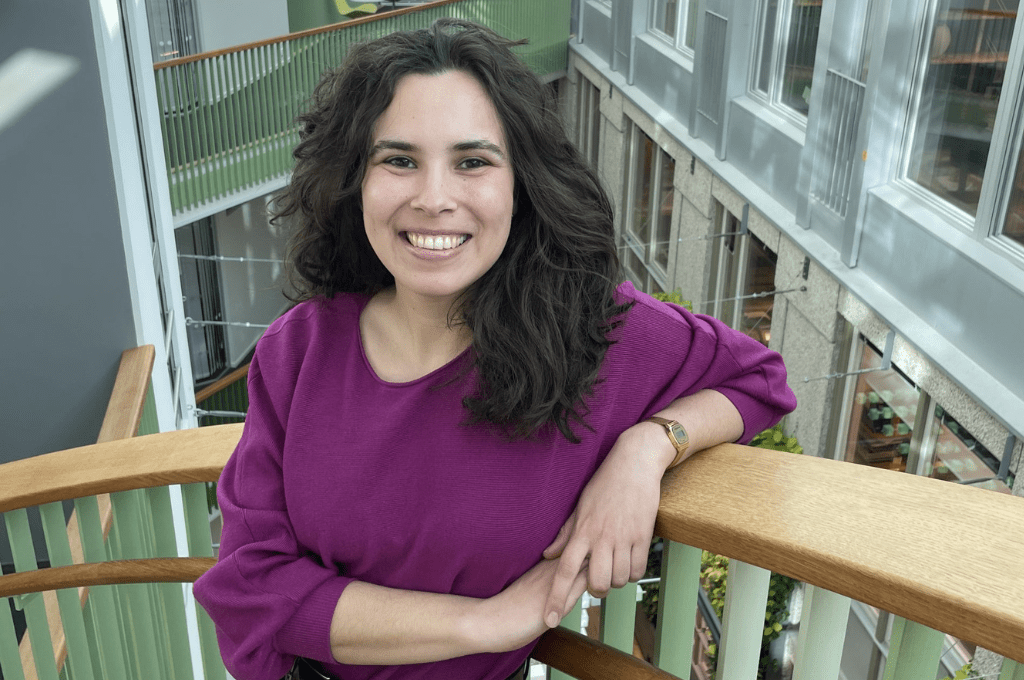

SciLifeLab Fellow Series: Mafalda Sousa Ferreira
Continuing our SciLifeLab Fellow Series, where we meet some of the researchers working at SciLifeLab. We talk to Mafalda Sousa Ferreira, who studies how species adapt to seasonal environments via genetic changes in their genome.
Can you tell us a bit about your academic background?
My background is in biology, and I completed a PhD in 2021 in Biodiversity, Genetics, and Evolution at the University of Porto, in Portugal. My PhD research was conducted at CIBIO-BIOPOLIS, a research center in Porto focused on Biodiversity research, and at the University of Montana in the USA. My thesis work focused on using genomics to understand evolution using hares as a study system. I studied hybridization among hare species and how that contributed to adaptation. I also studied the evolution of seasonal camouflage, a trait that involves a seasonal color change between white and brown.
After my PhD, I decided I had to expand my horizons and moved to Sweden for a Postdoc at Uppsala University. There, I studied herring evolution. More specifically, I was interested in the role of chromosomal inversions for adaptation to marine environments. A Marie Curie Postdoctoral Fellowship supported my work at Uppsala. This strong background in evolutionary biology and adaptation is now guiding my work as an independent researcher at SciLifeLab.
How do you see your expertise contributing to the SciLifeLab research environment?
SciLifeLab’s research has traditionally focused on molecular biology and life sciences, particularly in human health and drug discovery. I hope my research can help expand SciLifeLab’s research programs and expertise to include biodiversity research. For example, I use many of the same tools as other colleagues at SciLifeLab, such as genomics tools. Still, I adapt them and apply them to research on non-model organisms and difficult samples collected directly in the field or in natural history collections.
I would like to collaborate with SciLifeLab’s infrastructure to broaden the scope of their services for the biodiversity research community, so that Sweden can continue to lead in studies of evolution and biodiversity.
Could you describe your research in a way that’s easy to understand?
I am interested in how species adapt to seasonal environments via genetic changes in their genome. We all know how experiencing different seasons can affect our health and mood, and we have found ways to adapt to them. Organisms that live in natural conditions have to develop ways to tolerate seasons as well. For instance, some animals migrate or hibernate during winter. Others find ways to tolerate winter, which may involve physiological or morphological changes in their bodies. How these adaptations evolve over time and respond to natural selection is a central question in my research.
To understand this, I study a particular seasonal trait called seasonal color change. Species like mountain hares or willow ptarmigan change their color in winter to white to camouflage against snow. By focusing on this trait, I am able to understand the genetic mechanisms that allow animals to adapt to changes in their bodies to seasonal conditions in their environments. I also want to understand how animals respond to changes in the seasonal environment, such as when winters become shorter.
What do you hope to gain from the SciLifeLab Fellows program and the network it offers?
I’m excited to be part of a vibrant network that brings together cutting-edge technologies and interdisciplinary expertise. I hope to form new collaborations, learn from colleagues in adjacent fields, and use SciLifeLab’s infrastructure to advance my research in ways that wouldn’t be possible otherwise. For instance, I am really excited about the prospect of using single-cell genomics and spatial transcriptomics to study camouflage.
What’s one thing about you that people might be surprised to learn?
I like knitting and crocheting in my spare time, and I dream about having my own craft business. One day 😉
Where do you see yourself professionally in five years?
In five years, I would like to have built a successful and happy research group that is using the most modern tools available to understand and predict evolution in a changing world. In particular, I would like to incorporate more functional genomics and molecular biology into my research.
I would also like to have been successful at establishing collaborations within SciLifeLab to improve the representation of green biology and contribute to the development of technology for biodiversity research that can benefit the Swedish research community.
In one word, how would you describe your feelings about becoming a SciLifeLab Fellow?
Exciting!